


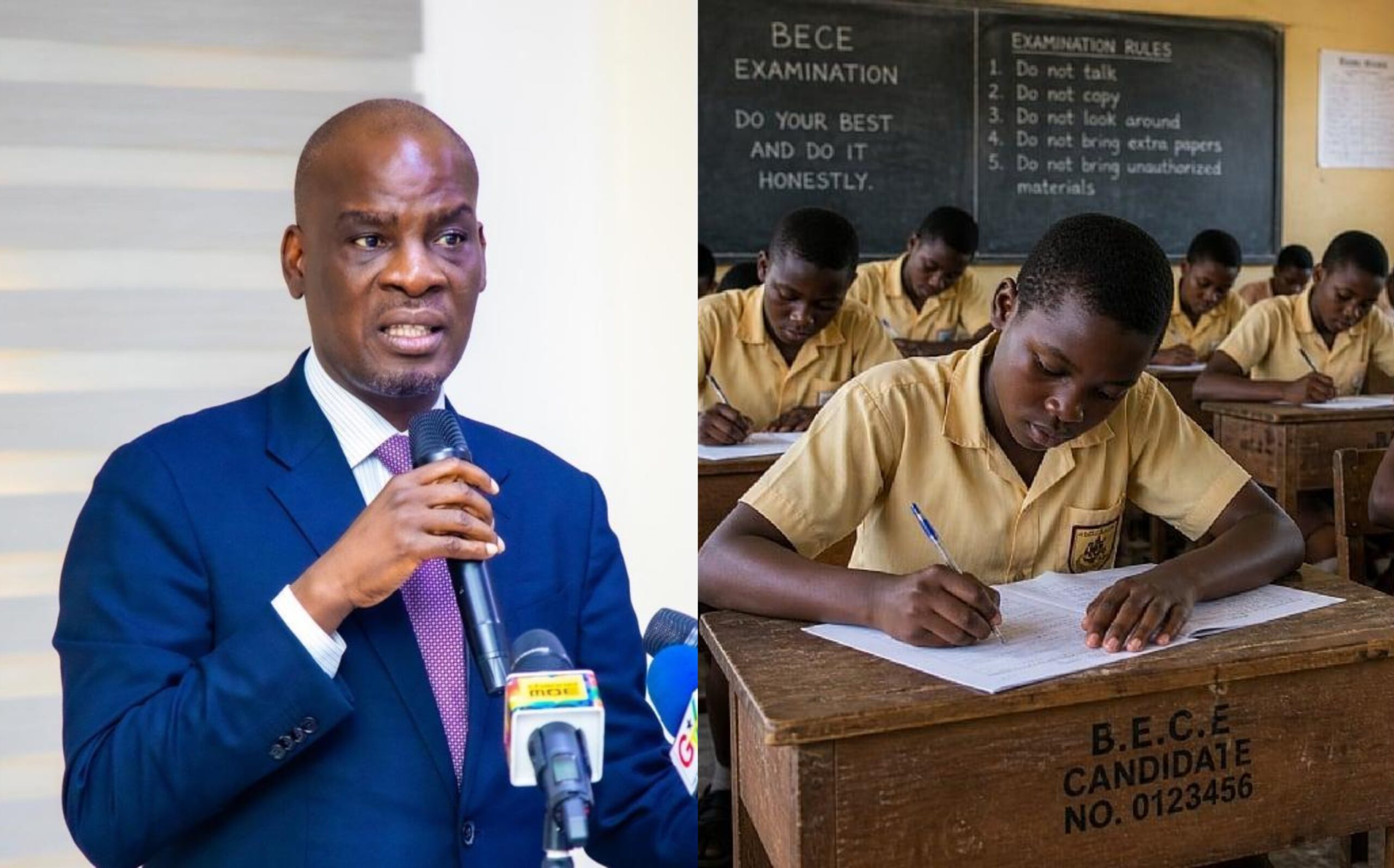
Ghana’s decision to impose a two-year examination ban on Junior High School (JHS) 1 and 2 pupils who attempt to sit the Basic Education Certificate Examination (BECE) early has opened a much bigger debate than whether children should be allowed to complete basic education ahead of their peers.
At the centre of the controversy are questions about the integrity of school records, parental pressure, the treatment of gifted children and whether the punishment announced by Education Minister Haruna Iddrisu addresses the people responsible for any wrongdoing.
The concerns became sharper after Ketu North MP Eric Edem Agbana alleged that some school heads falsify pupils’ continuous assessment records to enable them to register for the examination before completing the required three years of junior high school.
Speaking on TV3’s New Day, Agbana argued that schools are expected to submit cumulative assessment records covering JHS 1, JHS 2 and JHS 3, making it difficult for a pupil in the first or second year to meet that requirement legitimately.
“When students in JHS 1 are sitting for these exams, in most instances the heads of those schools are forced to engage in criminality of forging the records for those students because of a continuous assessment,” he said.
He called for investigations into the alleged practice and insisted that school heads found to have falsified academic records should be held accountable.
The allegation raises an uncomfortable question for the education authorities: if adults are manipulating the system to get children into the examination, why should the most visible punishment fall on the children?
Why Haruna Iddrisu Wants to Stop Early BECE Entries
Iddrisu announced the two-year restriction on November 23, 2026, at the opening of the 2026 National Education Week in Accra.
He directed the Ghana Education Service (GES) to communicate the measure to regional directors and heads of basic schools for immediate implementation.
The minister said the practice of pupils advancing themselves from JHS 1 or JHS 2 to sit the BECE ahead of schedule undermines discipline, fairness and effective education planning.
“We are doing this to instil discipline and to allow for effective planning, so that we know that every year this is the total number of students expected to graduate from BECE and not the numbers that we are witnessing,” he said.
His concern is not entirely about examination results. Predictable candidate numbers help education authorities plan for examinations and the transition of pupils into senior high school.
There is also an established eligibility requirement. WAEC says regular pupils must complete all three years of junior high school before sitting the school-candidate BECE.
Lilian Frimpong, WAEC’s Deputy Director of Public Affairs, has clarified that regular JHS pupils are not eligible to register for the private BECE, which is intended for people outside regular schooling who meet the relevant conditions and candidates seeking to improve previous results.
“For us, WAEC, if you haven’t gotten to Form Three and you write the exams, we usually see those candidates and we rate them as unqualified candidates,” she said.
She explained that the three years of continuous assessment form part of the requirements for school candidates.
This is an important distinction: the minister’s announcement is not simply creating a new expectation that pupils complete JHS 1 to JHS 3. It is seeking to enforce an existing examination requirement with a tougher consequence for early entry.
The Bigger Problem: Can Ghana Actually Enforce the Ban?
Agbana’s allegation about falsified assessment records points to one possible route through which early candidates may be registered. But there is another problem: how can authorities reliably identify pupils who attempt to bypass the rules, particularly when they move between schools?
Kofi Asare, Executive Director of Africa Education Watch, believes the absence of a unique student identification system could undermine the government’s approach.
Speaking on Joy FM’s Top Story, he said similar restrictions had been announced several times over the past decade without effectively stopping the practice.
“There’s no system. There’s no evidence to enforce the ban because we don’t have a unique student identifier in Ghana,” he said.
A unique identification number for every pupil, whether in a public or private school, would allow authorities to follow a child’s academic progression even when the pupil changes schools.
Without such a mechanism, enforcement could depend heavily on the accuracy of records submitted by individual schools and the ability of GES and WAEC to detect irregular registrations.
Asare also acknowledged that some children are exceptionally gifted and may be capable of progressing faster than their peers. He argued that the government should develop a framework for exceptional cases instead of relying on a blanket restriction.
“The intention behind the minister’s ban is good, but the reality is that this is about the fifth time here, about this ban in 10 years,” he said.
That warning deserves attention. Announcing a tougher penalty does not automatically close the loopholes that have allowed the practice to continue.
Should Pupils Bear the Consequences of Adults’ Decisions?
The two-year ban raises a difficult question about responsibility.
Consider a pupil whose parents insist on early examination entry and a school that agrees to register the child. If the school falsifies assessment records, the pupil may have little understanding of the administrative requirements or the implications of the decision.
Should that child face the same two-year restriction as someone who knowingly attempts to circumvent the rules?
Agbana believes school heads involved in falsifying records must be investigated and held accountable. That is an important part of the debate because a policy focused only on pupils may leave the adults facilitating the practice untouched.
The government has a legitimate responsibility to protect the credibility of national examinations. But effective enforcement should identify who initiated an irregular registration, who approved it, whether records were falsified and what each person’s responsibility was.
The published announcement does not yet explain how such cases will be investigated, whether pupils will have an opportunity to appeal or how the authorities will distinguish between deliberate misconduct and decisions made by parents or school administrators.
Those details matter, particularly because a two-year delay could affect a child’s educational progression.
What About Gifted Children and Homeschooled Pupils?
Not every case of early examination entry necessarily reflects an attempt to manipulate the system.
Some children demonstrate exceptional academic ability and may be ready to progress faster than their classmates. That does not automatically mean they have completed the wider curriculum or acquired the social and developmental experiences expected at each stage of basic education.
However, treating every early candidate as an offender risks overlooking children whose circumstances genuinely require a different academic pathway.
The question is not whether gifted pupils should be allowed to bypass educational standards. It is whether Ghana has a transparent process for assessing exceptional cases and determining when accelerated progression is appropriate.
Agbana also raised concerns about homeschooled children, asking how they would demonstrate compliance with continuous assessment requirements when they eventually seek to sit the national examination.
WAEC’s clarification that the private BECE is available to eligible first-time candidates outside regular schools, with a minimum age requirement of 13, provides part of the answer. But the authorities still need to explain how homeschooled learners can document their academic progress and meet the relevant examination requirements without being forced into arrangements that compromise the integrity of their records.
A Ban Alone Will Not Fix the Problem
There is support for the government’s decision. The Ghana National Council of Private Schools (GNACOPS), for instance, has endorsed the two-year restriction, arguing that pupils should complete the full curriculum rather than seek shortcuts.
“Education is a process, not a shortcut,” the council said in a statement.
However, it also warned that examination rules must be enforced alongside fairness in assessment and school placement, and called for an independent technical review of BECE outcomes.
That position highlights a broader issue. Parents’ decisions are influenced not only by academic ambition but also by their perceptions of examination results, school placement and the opportunities available to their children.
The Ministry of Education therefore has more work to do than issue a directive.
It must establish how early registrations are being facilitated, investigate allegations of fabricated assessment records, strengthen pupil identification and tracking, and explain how exceptional learners and homeschooled children will be treated.
It must also make clear how responsibility will be determined when an irregular registration occurs and what safeguards will protect pupils from being punished for decisions made by adults.
Haruna Iddrisu is right to insist that national examinations should operate under clear and consistent rules. But the success of this policy will not be measured by how many pupils are banned from sitting the BECE.
It will be measured by whether the system becomes harder to manipulate, whether schools and parents are held accountable for wrongdoing, and whether children are treated fairly.
If the problem involves adults manipulating school records to get children into the examination early, Ghana must ensure that its response does not stop at punishing the children.

