

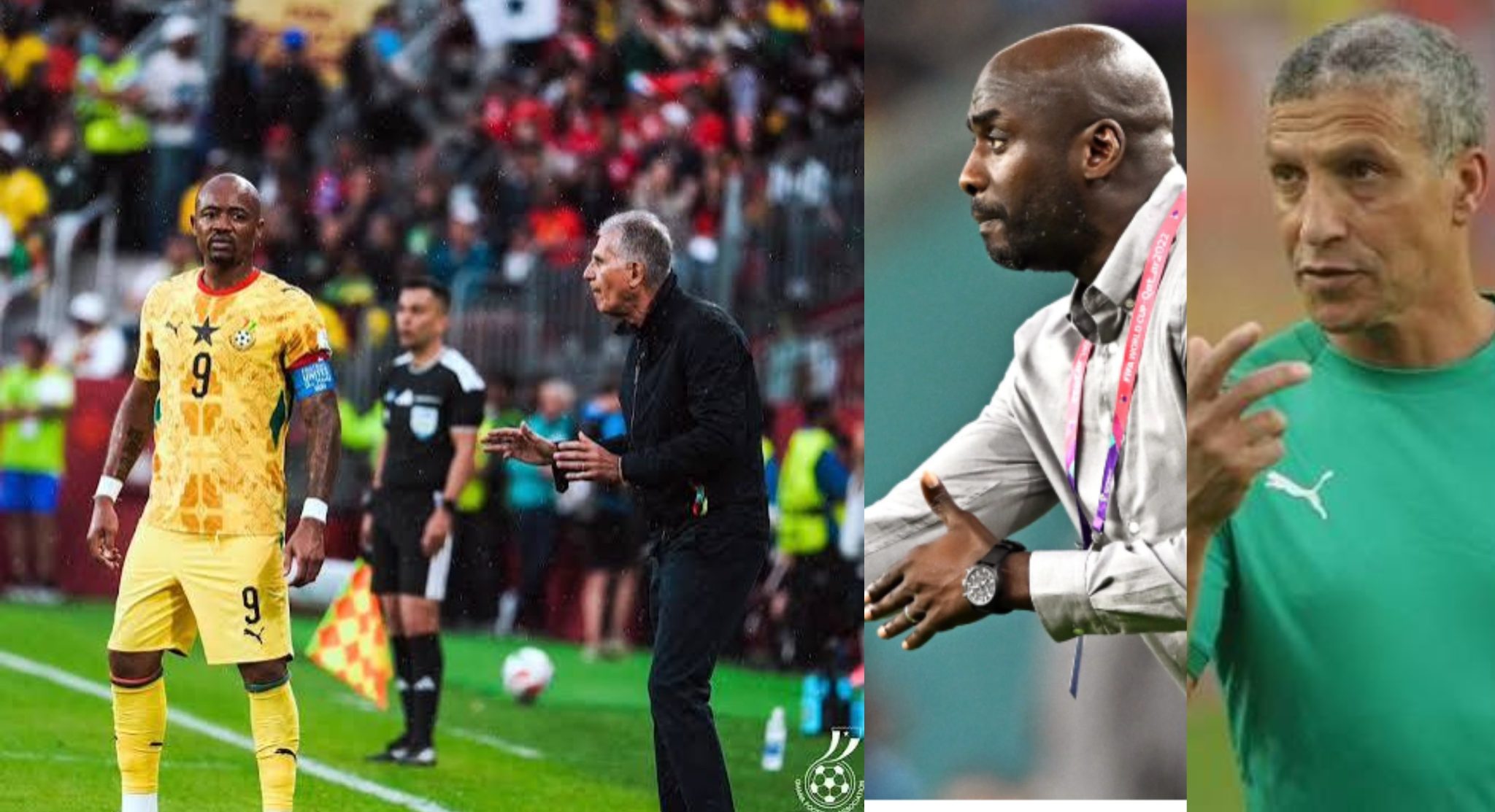
Carlos Queiroz’s departure has added another chapter to the Ghana Black Stars’ long history of coaching changes, renewing questions about the national team’s technical direction and the search for lasting stability.
The Ghana Football Association (GFA) and the Portuguese coach mutually agreed to terminate his contract on October 1, 2026, following discussions after Ghana’s disappointing start to the 2027 Africa Cup of Nations (AFCON) qualifying campaign. The Black Stars had lost their opening two matches against Côte d’Ivoire and The Gambia. Read the GFA’s announcement.
Queiroz’s departure means Ghana must once again consider a new coaching appointment, continuing a pattern that has characterised the Black Stars over the past two decades.
Since Ghana’s first FIFA World Cup appearance in 2006, 10 permanent head coaches have held the position, although several have served more than one spell. Their tenures have produced memorable achievements, including the 2010 World Cup quarter-final run, as well as disappointing tournament exits and qualifying setbacks.
The recurring changes have raised questions about whether Ghana can balance the demand for immediate results with the patience required to build a competitive national team.
The 10 Black Stars coaches since 2006
From Ratomir Dujković’s historic World Cup campaign to Queiroz’s short spells in 2026, each coach has faced different expectations and circumstances.
| Coach | Period in charge | How their tenure ended |
|---|---|---|
| Ratomir Dujković | 2004–2006 | His tenure ended after guiding Ghana to the Round of 16 at the 2006 FIFA World Cup, the country’s first appearance at the tournament. |
| Claude Le Roy | 2006–2008 | Left after leading Ghana to third place at the 2008 AFCON, hosted by Ghana. |
| Milovan Rajevac | 2008–2010; 2021–2022 | His first spell ended after Ghana reached the 2010 World Cup quarter-finals. His return ended following Ghana’s disappointing 2021 AFCON campaign. |
| Goran Stevanović | 2011–2012 | His contract was terminated after Ghana’s semi-final exit at the 2012 AFCON. |
| Kwesi Appiah | 2012–2014; 2017–2020 | His first spell ended after Ghana’s 2014 World Cup campaign. He returned in 2017 before his second tenure ended in 2020. |
| Avram Grant | 2014–2017 | Departed after Ghana finished fourth at the 2017 AFCON, with his contract coming to an end. |
| Charles Akonnor | 2020–2021 | Was dismissed during Ghana’s 2022 World Cup qualifying campaign following a poor run of results. |
| Otto Addo | 2022; 2024–2026 | His first spell ended after the 2022 World Cup. He returned in 2024 before leaving the role in March 2026. |
| Chris Hughton | 2023–2024 | Was dismissed after Ghana’s group-stage elimination at the 2023 AFCON, which was played in early 2024. |
| Carlos Queiroz | April–July 2026; September–October 2026 | His first spell ended after Ghana’s 2026 World Cup campaign. Following his return in September, he and the GFA mutually agreed to terminate their contract on October 1. |
The timeline covers permanent head coaches and does not count interim appointments separately. Coaches who returned for a second spell are counted once.
Why Ghana has struggled with coaching stability
The Black Stars coaching position carries considerable pressure because of Ghana’s history in African and international football.
Ghana have won the AFCON four times and reached the quarter-finals of the FIFA World Cup in 2010. Those achievements have shaped expectations among supporters, who often demand immediate progress whenever a new coach takes charge.
However, success at international level requires more than appointing an experienced manager. Coaches need adequate preparation time, a settled squad, effective support staff and a clear working relationship with the football authorities.
Frequent changes can disrupt tactical plans and make it difficult to establish continuity. A new coach may introduce different playing methods, select different players or alter the team’s approach to major competitions.
At the same time, poor results cannot simply be ignored. Coaches are judged on performances, and tournament exits or qualifying setbacks can intensify pressure for change.
Ghana’s coaching history therefore reflects a recurring challenge: how to balance accountability for results with the patience required to build a competitive national team.
From the 2010 World Cup high to recent disappointments
Rajevac’s first spell remains one of the defining periods in the Black Stars’ modern history. Ghana reached the 2010 World Cup quarter-finals in South Africa, becoming only the third African team to reach that stage at the time.
The team came close to making the semi-finals but lost to Uruguay on penalties after a dramatic match that included a late extra-time handball and a missed penalty by Asamoah Gyan.
That campaign established a benchmark against which subsequent teams and coaches have often been judged.
Ghana’s later campaigns, however, have been marked by inconsistency. The Black Stars exited the 2014 World Cup in the group stage, failed to qualify for the 2018 tournament, and suffered group-stage eliminations at the 2021 and 2023 AFCON tournaments.
The coaching changes have reflected the pressure generated by these results, but they have not, on their own, resolved the broader challenges facing the national team.
What Carlos Queiroz’s departure means for Ghana
Queiroz arrived in April 2026 with extensive international experience, having managed national teams including Portugal, Iran, Colombia and Egypt.
His initial mandate was to lead Ghana at the 2026 World Cup. The Black Stars advanced to the Round of 32 before losing to Colombia, after which his first spell came to an end.
The GFA reappointed him in September, giving him another mandate ahead of the 2027 AFCON qualifying campaign.
That second spell lasted only weeks. Ghana lost 2-0 away to Côte d’Ivoire before suffering a 4-2 defeat against The Gambia, leaving the team without a point from its opening two qualifying matches.
The GFA subsequently announced that both parties had agreed to terminate their professional relationship.
Queiroz’s departure highlights the difficulty of moving from a short World Cup assignment to a longer-term rebuilding project, particularly when results deteriorate quickly. It also leaves the GFA with the responsibility of determining the Black Stars’ next technical direction.
Can Ghana finally achieve greater stability?
The repeated changes in the Black Stars dugout raise a broader question about the kind of football project Ghana wants to build.
A long-term approach would require clearly defined objectives, an effective player-development structure and agreement between the coach and football authorities on recruitment, selection and technical responsibilities.
It would also require realistic performance targets. Stability should not mean retaining a coach regardless of results, just as a disappointing run should not automatically erase the value of a longer-term plan.
Ghana’s experiences since 2006 show that appointing a new manager is only one part of the challenge. Building a team capable of competing consistently at major tournaments requires coordination across the technical team, players and football administration.
As the Black Stars prepare for another transition, the central issue is whether Ghana can turn its next coaching appointment into part of a sustained football strategy rather than another short-lived change.