
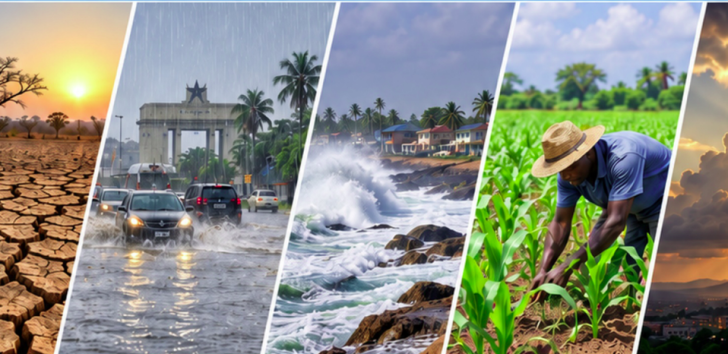
The Ghana Meteorological Agency (GMet) has warned that persistent El Niño conditions could expose parts of Ghana to prolonged dry spells, potentially affecting agricultural production, water availability and food security.
The agency says the current El Niño is particularly strong and could persist until at least the first half of 2027, raising concerns about its possible effects on several sectors of the economy.
El Niño is the warm phase of the El Niño-Southern Oscillation (ENSO), a naturally occurring climate pattern involving changes in sea surface temperatures and atmospheric conditions over the tropical Pacific Ocean. These changes can influence temperature and rainfall patterns in different parts of the world.
However, El Niño does not determine the weather of every country on its own. Its effects vary by region and season and interact with other atmospheric and oceanic conditions, as well as local weather systems. In Ghana, its possible influence must therefore be considered alongside other factors that shape the country’s rainfall and temperature patterns.
Speaking in an interview with Citi FM on Monday, November 2, GMet Director-General Dr Eric Asuman said the agency’s monitoring had confirmed that the country was experiencing a very strong El Niño.
“All the models we’ve monitored from June this year have seen the temperatures rising, the warming rising in the Pacific Ocean, to the level that now we find ourselves in a very strong El Niño,” he said.
He added that the conditions were expected to persist into the following year.
“And so, as we noticed, the global models and analysis are showing that now we are in a very strong El Niño stage, and that is going to continue until at least the first half of next year,” he said.
What Ghana Can Expect
GMet Deputy Director of Research and Applied Meteorology, Francisca Martey, said the agency’s September-October-November seasonal forecast had anticipated below-normal rainfall across most parts of Ghana, alongside above-normal temperatures and extended dry spells.
Speaking on Joy FM’s Super Morning Show on Monday, November 2, she said much of the country had already experienced relatively dry conditions and limited rainfall since September.
“We’re going to have long dry spells. We’re going to have below-normal rainfall,” she said.
According to her, the conditions could persist into the December-January-February period, which coincides with the Harmattan season.
“We are expecting that with this timing it will continue. The Harmattan will come in. The Harmattan will be drier,” she said.
She also forecast warmer temperatures during the period.
“We expect that December, January, and February will be warmer,” she stated.
Mrs Martey warned that northern Ghana could experience greater effects because of the region’s vulnerability to rainfall deficits and its importance to the country’s food production.
“Although the El Niño affects the whole country, its impact is higher on the northern areas,” she said.
Possible Effects on Agriculture, Water and Energy
Prolonged dry spells could affect farming, particularly in areas where farmers depend on rainfall and stored water for cultivation.
Mrs Martey cautioned that water saved by some communities and farmers could gradually dry up if the dry conditions persist.
“The little rainwater that they have kept or saved would also dry up,” she said.
She urged farmers to adopt climate-smart agricultural practices, including mulching, to help conserve soil moisture. She also advised them to remain alert to crop pests and diseases that could become a challenge under the prevailing weather conditions.
“We are expecting that they will practise more mulching systems and climate-smart agricultural systems,” she said.
The possible effects extend beyond farming. Reduced rainfall across parts of West Africa could affect water resources shared by Ghana and neighbouring countries, with implications for the Volta River system.
Mrs Martey also acknowledged that reduced inflows into the Akosombo Dam could affect hydroelectric power generation.
Higher temperatures could also create health concerns, while prolonged dry conditions could increase the risk of bushfires. GMet has cautioned that erratic showers may still occur, meaning the possibility of flooding cannot be ruled out.
What Government Agencies Are Expected to Do
Dr Asuman said GMet had submitted a comprehensive report to its supervising ministry and government before making the warning public. He expects the relevant institutions to use the information in their planning and operations.
“The information has gone to the government. The sectors that we have mentioned will take this information into their planning, engagements and activities,” he said.
He explained that the Ministry of Agriculture should use the forecast to guide decisions on the types of seeds farmers are encouraged to plant, while agricultural extension officers should provide farmers with appropriate guidance.
He also said the Ghana Cocoa Board should consider how rising temperatures could affect cocoa-related diseases and the quality of production.
On public safety, Dr Asuman said fire service committees should put measures in place to prevent bushfires, while emergency services should prepare for the possibility of flooding from irregular showers.
He further urged the health sector to use the climate information in its planning, noting that high temperatures could create conditions associated with health risks such as meningitis.
For the energy sector, he said GMet would continue working with the Volta River Authority (VRA), providing updates every 10 days and supporting the monitoring of water inflows into the Akosombo Dam.
“We’re expecting that the Volta River Authority, with which we have a very close working relationship, will be given updates every 10 days. We move with them, give them access to this document, guide them as we monitor the flows into the dam, and they use it in their work,” he said.
Dr Asuman stressed that GMet’s role was to provide early warning information, while the institutions responsible for the affected sectors were expected to translate the forecasts into practical measures.
“So, what we do next is provide an early warning and then expect the various sectors that are affected to use this information to prepare,” he said.
What Farmers and the Public Can Do
For farmers, the advice from GMet includes adopting mulching and other climate-smart practices, considering drought-tolerant and early-maturing crop varieties, and remaining vigilant against pests and diseases.
The public has also been urged to take precautions against the expected hot and dusty conditions, including staying hydrated and protecting themselves from dust.
The agency’s warning also highlights the need for communities and relevant institutions to remain alert to changing weather conditions, including the possibility of irregular rainfall and flooding.
The Need for Preparedness
GMet’s warning provides an early indication of the weather-related pressures Ghana could face in the coming months. But the extent of the impact will depend not only on the strength and duration of El Niño, but also on how other weather conditions develop and how effectively institutions respond.
Dr Asuman said the agency had already shared its report with the government, placing responsibility on the relevant sectors to incorporate the information into their plans.
The key question now is how effectively those institutions will turn the early warning into practical action to protect farmers, water resources, public health and the country’s energy supply.