

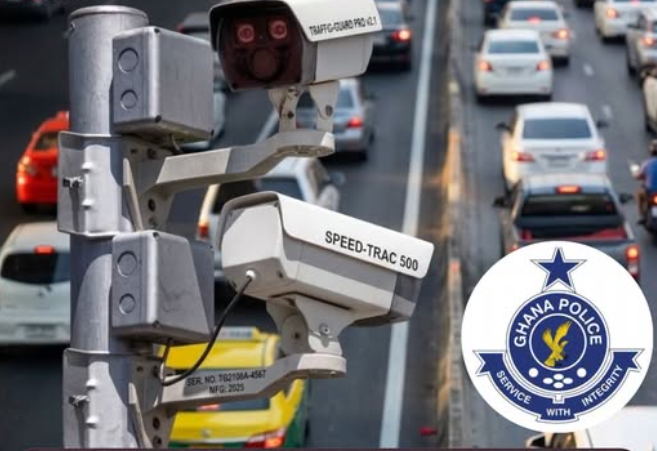
Ghana’s new automated traffic enforcement system, TRAFFITECH-GH, has sent an early warning to motorists who disregard speed limits, with the Police reporting thousands of speeding offences on its first two days of full implementation.
The system became operational on Sunday, November 1, 2026, and has already attracted public attention, with some motorists reporting that they have received electronic traffic notices supported by video evidence.
One motorist, for instance, claimed on social media that she had been fined GH¢240 after driving at 60km/h on the GIMPA Road, where she said the speed limit was 50km/h.
“I did 60km/h on the GIMPA Road, where the speed limit is 50km/h, and TRAFFITECH has charged me GH¢240 for speeding. They even sent me a whole video. These people will make money today,” she wrote.
Her account offers an early illustration of how the system is expected to operate, as motorists can now receive electronic notices without necessarily being stopped by a police officer.
However, the rollout has also raised questions about public education, road signage and whether the country’s infrastructure is adequately prepared for stricter automated enforcement.
Police Report Thousands of Speeding Offences
Speaking on Joy FM’s Super Morning Show on Monday, November 2, ACP Alexander Kwaku Obeng, Director of Education, Research and Training at the Motor Traffic and Transport Department (MTTD), said the system had recorded thousands of speeding offences on its first day.
He disclosed that some motorists had been captured travelling above 130km/h on roads with a 50km/h speed limit. He cited Mahama Road, from Boundary Road, as one of the locations where excessive speeding had been detected.
The Police have not disclosed the exact number of electronic violation notices issued during the first day of implementation.
According to the MTTD, speeding accounts for between 60 and 62 per cent of serious injuries and fatalities resulting from road crashes in Ghana. The Police say the system is intended to improve compliance with speed limits and reduce road accidents.
How Much Can Motorists Be Fined?
The GH¢240 fine reported by the motorist on GIMPA Road corresponds with the announced minimum penalty for drivers caught travelling between 5km/h and 20km/h above the prescribed speed limit.
The system uses cameras and other monitoring equipment to detect suspected traffic offences. Police personnel review the captured footage before an electronic notice is sent to the registered owner of the vehicle.
The notice contains details of the alleged offence, including the vehicle, date, time and location, alongside photographic or video evidence.
Motorists have 14 days to pay the fine or challenge the notice through the prescribed process.
The MTTD has outlined general speed limits of 50km/h in built-up areas, 90km/h on highways and 100km/h on motorways. Lower limits also apply in designated areas, including school zones.
Manasseh Azure Questions Fairness of Enforcement
While the system is intended to strengthen compliance with traffic regulations, journalist Manasseh Azure Awuni has questioned whether motorists are being adequately informed about the speed limits they are expected to observe.
In a Facebook post on Monday, November 2, he raised concerns about the 30km/h speed limit in school zones, asking how drivers could identify such areas when some schools did not have visible signposts.
Drawing on his experience driving in the United States, he argued that speed limits and other road regulations should be clearly displayed to guide motorists.
“If the aim of Traffitech is to keep our roads safe and not to spring surprises on motorists and make money, the state should help drivers to know where and what regulation applies,” he wrote.
He called for speed limits, road lanes and areas monitored by traffic cameras to be clearly marked. He also urged city authorities to address billboards obstructing motorists’ views of traffic lights and road signs.
His criticism highlights a key question surrounding the rollout: motorists are responsible for obeying traffic regulations, but authorities must also ensure that the applicable rules are clearly communicated.
Other Critics Raise Public Education Concerns
Ibrahim Adjei, Resident Country Director of International Investments LLC, has also questioned the level of public education ahead of the implementation.
Speaking on ChannelOne TV’s Breakfast Daily, he said he had not seen sufficient public communication explaining the new system.
“I haven’t seen any advert. We normally do adverts in a very humorous way and in a way that sends a message that helps society. I’m not seeing any advert speaking to this policy, this TraffiTech implementation, not one,” he said.
Policy analyst and civil society activist Dr Steve Manteaw has separately raised concerns about restrictions on drivers’ use of certain devices for navigation, arguing that they could affect hail-and-ride operators.
“To prevent the use of such devices in Ghana is absurd and likely to impact negatively on hail-and-ride operators,” he wrote on Facebook.
Police Defend TRAFFITECH’s Focus on Speeding
The Police have maintained that TRAFFITECH-GH is primarily intended to enforce speed limits and should not be viewed as a solution to every road safety challenge.
ACP Obeng has said the system’s initial implementation focuses on speeding, while officers will continue to enforce other traffic regulations through conventional means.
The Police have also cited reductions in road crashes, injuries and fatalities recorded in September 2026 compared with the same month in 2025. Crashes reportedly fell by 9.4 per cent, injuries by 15.02 per cent and fatalities by 7.82 per cent.
However, these figures relate to the period before full implementation of TRAFFITECH-GH and do not establish the system’s impact after its November 1 rollout.
Will TRAFFITECH-GH Make Ghana’s Roads Safer?
The first day of implementation has demonstrated the potential of automated monitoring to make speeding more difficult to escape detection. But the system’s long-term success will depend on more than the number of motorists captured or fines issued.
Clear road signage, effective public education, reliable infrastructure and a transparent process for challenging disputed notices will be important to ensuring that enforcement is both effective and fair.
Whether TRAFFITECH-GH will translate into lasting improvements in road safety remains to be seen. For now, its rollout has brought a new reality to Ghanaian motorists: speeding can be detected and documented even when no police officer is physically present.