


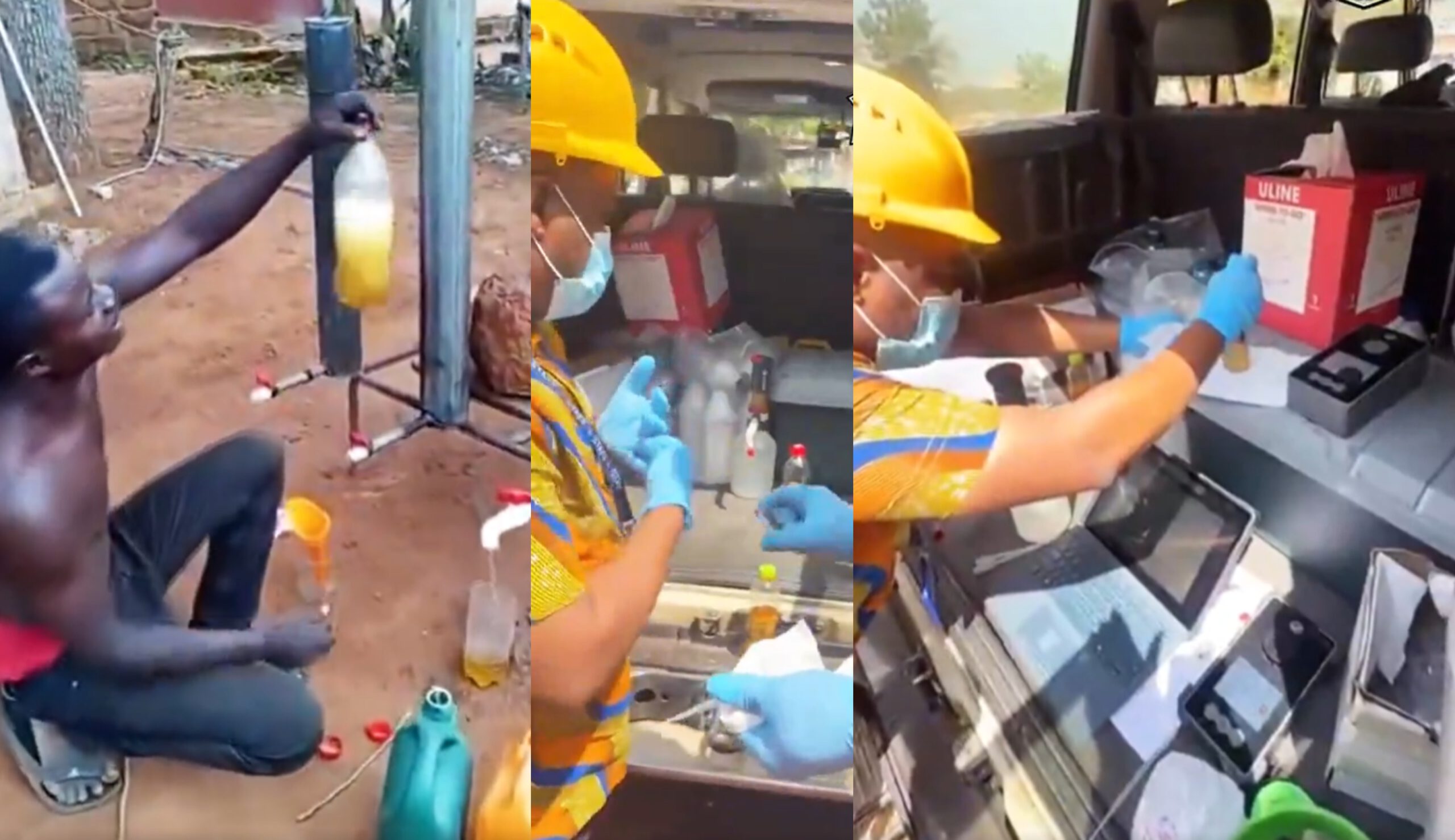
The National Petroleum Authority (NPA) has raised concerns about the quality of fuel produced by a man using plastic waste at Asesewa in the Eastern Region after preliminary tests found that the products did not meet the required standards for use in motor vehicles.
The development follows the circulation of videos showing the unnamed local inventor operating a makeshift fuel processing facility, where he uses locally assembled equipment to convert discarded plastic materials into liquid products.
The footage attracted considerable attention online, with many Ghanaians praising his ingenuity and calling on the government to support him in developing the idea.
Following the public interest in the project, an NPA delegation dispatched by its Chief Executive, Edudzi Tameklo, visited Asesewa to examine the facility and assess the products.
The officials conducted preliminary tests on samples of the fuel using equipment brought to the site. The initial findings indicated that the products did not meet the required specifications for automotive use. Samples were subsequently collected for further laboratory analysis in Accra.
Inventor Explains How He Produces The Fuel
During the visit, the officials interacted with the inventor through a translator as he demonstrated the equipment and explained the process of converting plastic waste into different fuel products.
He showed the team how he heats the materials in a chamber and monitors the temperature during production.
Pointing to one of the products, he identified it as petrol.
“So this one is a petrol,” he said.
He also explained the role of temperature in determining the products obtained from the process, pointing to a measuring instrument as he described how it works.
“So this particular metre over here is the temperature, temperature,” he said.
“So, for instance, the higher the heat, the lighter the product,” he added.
The demonstration allowed the officials to observe the production process and collect samples for testing.
NPA Warns Motorists Against Using The Fuel
Despite acknowledging the man’s initiative, the NPA officials cautioned motorists against using the products because of the concerns raised by the preliminary tests.
The samples taken to Accra will undergo further laboratory analysis to establish their composition and whether they meet the specifications required for petrol and diesel used in vehicles.
The distinction is important because a liquid produced from plastic waste cannot be considered suitable automotive fuel simply because it resembles conventional petrol or diesel.
NPA Considers Possible Support For The Inventor
Although the preliminary findings raised concerns about the products, the officials commended the inventor’s initiative and indicated that the NPA would consider whether there were ways to help him develop his idea.
One of the officials said the delegation had been sent by the Chief Executive to assess the project and report back to him.
“What you see, our Chief Executive would welcome that idea wholeheartedly. We are here because he sent us to come and verify what is on the ground and then give him feedback,” the official said.
“So we’ll go back and give him our report. Then we’ll take it up from there,” the representative added.
The official also clarified that the inventor was not producing the fuel for commercial purposes but was pursuing the project out of personal interest.
“He’s not doing it for business. He’s not doing it for the market, and he has no hidden motives for engaging in this production,” the official said.
“It’s just a habit he has cultivated, and he’s nurturing it.”
The representative further suggested that the authority could explore ways to support the inventor, particularly because his work involves turning plastic waste into other products.
“So we also look at it if there’s a way we can support him to build it, especially so he’s producing things from plastic, from waste materials,” the official said.
The NPA has not announced any specific support package for the inventor. Its next steps will depend partly on the report from the delegation and the results of the further laboratory tests.

