


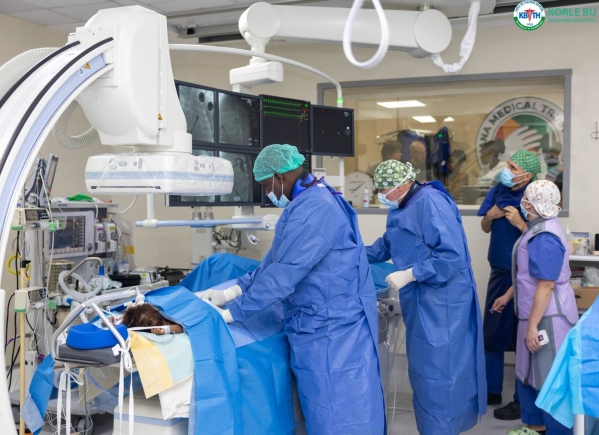
A teenager who needed a heart valve replacement did not have to undergo an operation involving an incision in her chest. Instead, doctors at Korle Bu Teaching Hospital reached her heart through a blood vessel in her thigh, completing the procedure in approximately one hour.
The 14-year-old underwent a minimally invasive pulmonary valve replacement at the hospital’s National Cardiothoracic Centre (NCTC), where specialists implanted a Harmony Valve using a technique known as transcatheter pulmonary valve replacement (TPVR).
The approach avoids conventional open-chest surgery by allowing doctors to guide a catheter through a blood vessel towards the heart and position the replacement valve.
After the procedure, medical assessments showed that the new valve was functioning well and the teenager was recovering. She was advised to rest for seven days and avoid heavy lifting while the incision in her leg healed.
Beyond the operation itself, the case highlights the role of specialised technology, international medical partnerships and investment in cardiac facilities in widening treatment options for children with heart conditions in Ghana.
How Doctors Reached the Heart Through the Thigh
The pulmonary valve regulates blood flow from the heart to the lungs. When it fails to close properly, blood can flow backwards into the heart, a condition known as pulmonary valve regurgitation. Over time, this can place additional strain on the heart.
With TPVR, doctors insert a catheter through a blood vessel, usually in the thigh, and guide it towards the heart. They then position the replacement valve without opening the chest.
The Harmony Valve used at Korle Bu is designed for patients with particular anatomical features, including an enlarged right ventricular outflow tract. It is not suitable for every patient with pulmonary valve disease. Doctors must first assess the patient’s condition and anatomy to determine whether the device is appropriate.
Why Detecting Heart Conditions Early Matters
Dr Katja Pauli, team lead for the German medical partners, stressed the importance of early diagnosis and timely treatment.
She noted that pulmonary valve insufficiency can occur on its own, without other heart conditions. Regular medical assessments are therefore important, while some congenital heart defects can also be detected during pregnancy.
Identifying these conditions early gives medical teams an opportunity to assess the risks and determine the appropriate care.
The Medical Partnership Supporting Children’s Heart Care
The procedure was carried out through a collaboration involving the NCTC, Germany-based Kinderherzen International and the Gerald Asamoah Foundation.
Gerald Asamoah’s involvement in the initiative is also rooted in his personal experience with heart disease. Read how his childhood heart condition inspired him to support free heart surgeries for children in Ghana
The partnership’s annual medical engagement brought together about 30 medical professionals who performed complex open-heart surgeries and cardiac catheterisation procedures on children with congenital heart diseases.
NCTC Director Dr Kow Entsua-Mensah described the Harmony Valve procedure as a significant milestone for specialised cardiac care in Ghana. He said the technology represents an advancement in transcatheter treatment and expressed pride that Ghana had joined countries performing the procedure.
The collaboration has also supported treatment for babies and children using the Centre’s newly installed Catheterisation Laboratory. Further procedures planned include the closure of Patent Ductus Arteriosus (PDA) and Atrial Septal Defect (ASD), congenital conditions that can affect normal blood flow.
What It Means for Children and Their Families
Access to specialised heart treatment can be difficult for families, particularly when a child needs an intervention that requires advanced equipment and specialist expertise.
Parents whose children benefited from the programme expressed gratitude, describing the treatment as a source of hope and relief. The beneficiaries received the interventions at no cost through the Centre, its partners and the Ghana Medical Trust Fund.
The Harmony Valve procedure does not mean that every child with a faulty pulmonary valve can receive the same treatment. Eligibility depends on individual medical assessments, while access to advanced procedures also requires appropriate equipment and trained specialists.
However, the work at Korle Bu demonstrates the treatment options that can become available when specialist expertise, technology and partnerships come together. For the 14-year-old, it meant receiving a replacement heart valve without having her chest opened.

