


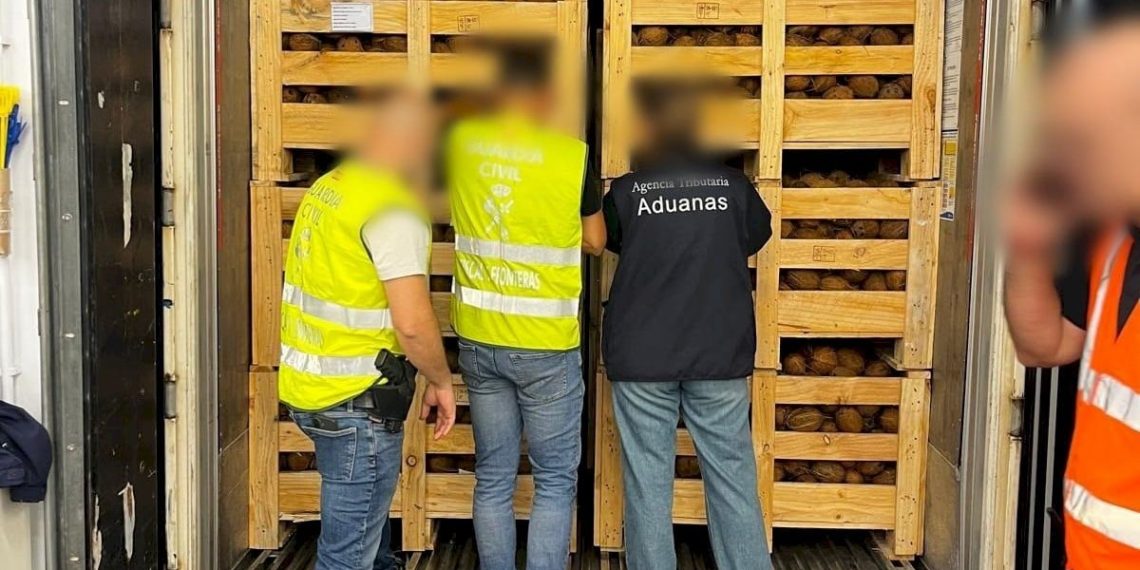
The seizure of 2,600 kilogrammes of cocaine from two shipping containers that originated from Ghana has renewed concerns about the country’s vulnerability to international drug trafficking and the effectiveness of its security systems.
Spanish authorities announced the seizure on November 11, 2026, after discovering the cocaine in a shipment that had travelled from Tema to the port of Valencia. The drugs were concealed in wooden boxes with false bottoms and declared as coconuts.
The containers were loaded at Tema on August 2 and arrived in Valencia on August 22. Spanish authorities said two men were arrested in Viator, Almeria, in connection with the operation. One was identified as the alleged importer and the other as the person responsible for unloading the shipment.
The Spanish authorities did not identify any Ghanaian suspect or establish who placed the cocaine in the containers. They also did not publicly explain how the shipment passed through the relevant security checks.
However, the discovery has added to a growing list of major drug interceptions involving consignments linked to Ghana, prompting renewed calls for investigations and accountability.
Calls for Accountability After the Spain Seizure
The latest interception has drawn criticism from public commentators and opposition politicians.
Professor H. Kwasi Prempeh, Executive Director of the Centre for Democratic Development Ghana (CDD-Ghana), challenged President John Mahama to demonstrate that his administration was prepared to hold public officials accountable.
Reacting to the developments, he urged the President to move beyond expressions of concern and take action against officials found to have failed in their responsibilities.
“Wake up, Mr Nice Guy!” he said.
The New Patriotic Party (NPP) has also demanded changes within the security agencies responsible for preventing drug trafficking.
At a press conference on November 4, the party’s Second National Vice-Chairman, Henry Nana Boakye, called on the heads of the Narcotics Control Commission (NACOC), Ghana Airports Company Limited (GACL), Ghana Ports and Harbours Authority (GPHA) and National Security to step aside to allow independent investigations.
He also called for the resignation of Interior Minister Muntaka Mohammed-Mubarak.
Mr Boakye said the party had identified 14 major cocaine and illicit drug seizures between March 2025 and October 2026, including seven in Ghana. According to the NPP, approximately four tonnes of cocaine had been seized within the country, while more than 12 tonnes linked to Ghana had been intercepted abroad.
Those figures represent the party’s account and should not be treated as an independently audited government total.
What the JoyNews Research Figures Reveal
A separate investigation by JoyNews Research provides another picture of the scale of the problem.
Its tally identified 28 drug seizures between March 2025 and September 22, 2026. Eleven involved cocaine, while the remaining 17 concerned cannabis, methamphetamine, heroin, pharmaceutical opioids and consignments whose specific substances were not publicly disclosed.
Seven of the 11 cocaine interceptions took place in Ghana, while four occurred abroad.
The research estimated the street value of the cocaine seized at between US$1.3 billion and US$1.7 billion.
By weight, the four foreign seizures accounted for approximately 12.4 tonnes, compared with about 3.6 tonnes from the seven seizures on Ghanaian soil for which weights were published. That puts the total at approximately 16 tonnes.
The figures suggest that considerably more Ghana-linked cocaine was intercepted abroad than was seized within the country during the period covered by the research.
The tally draws on reported seizures by NACOC, the National Intelligence Bureau, the Ghana Police Service and foreign authorities. It is not an official government accounting of every drug seizure.
The September 22 cutoff is also important. The Beirut interception on October 31 and the Valencia seizure announced on November 11 occurred after the period covered by the research.
Major Cocaine Seizures Linked to Ghana Abroad
Several large interceptions at foreign ports have placed Ghana under scrutiny.
Amsterdam: Nearly 4.5 Tonnes Hidden in Timber
On June 13, 2025, Dutch customs officials seized approximately 4,500 kilogrammes of cocaine concealed in a container carrying timber.
The Dutch Public Prosecution Service later confirmed that the timber came from a Ghanaian company and was destined for a German business. Investigators suspected the German company was being used as a front for international drug shipments.
The seizure was the largest cocaine discovery recorded at the port of Amsterdam at the time. A 69-year-old man was subsequently arrested in connection with the investigation.
Antwerp: Cocaine Concealed in Cassava Flour
On November 28, 2025, Belgian customs officials seized 2,829 kilogrammes of cocaine at the port of Antwerp.
The drugs were hidden inside a container carrying cassava flour from Ghana’s Tema Port. Belgium’s Federal Public Service Finance confirmed the seizure on December 2 and said the cocaine would be destroyed.
A further 1,158 kilogrammes of cocaine shipped from Ghana was reportedly seized at the same port in December 2025. JoyNews Research, however, noted that it had not established whether this was entirely separate from the November case. The two quantities should therefore not automatically be counted as separate incidents.
Dunkirk: Nearly 3.9 Tonnes in a Plastic Waste Shipment
In September 2026, French authorities seized approximately 3.9 tonnes of cocaine concealed in a container declared as plastic waste at the port of Dunkirk.
The shipment was linked to Ghana and reportedly had an estimated value of about €225 million.
The case attracted further attention because of alleged links to Dutch fugitive Jos Leijdekkers, popularly known as Bolle Jos.
The seizure led to arrests and court proceedings in Ghana. Four Ghanaian suspects were arraigned in connection with the case, while other accused persons faced separate proceedings.
The accused have denied the charges, and the allegations remain subject to the judicial process.
Importantly, the Dunkirk seizure and the approximately 3.9-tonne consignment intercepted at Tema Port in August 2026 refer to the same shipment. They should not be counted as two separate drug busts.
Beirut: Suspected Cocaine Found on Passenger from Accra
On October 31, 2026, Lebanese authorities arrested a Syrian national who had arrived at Rafik Hariri International Airport in Beirut from Accra.
Reports from Lebanon said officers discovered 46.7 kilogrammes of cocaine concealed in two suitcases.
NACOC subsequently said the consignment was allowed to leave Ghana as part of a controlled delivery operation involving Lebanese authorities. The Commission also announced arrests in Ghana in connection with the investigation.
There is a difference between the quantities reported by the Lebanese authorities and NACOC. While the Lebanese report put the seizure at 46.7 kilogrammes, NACOC referred to approximately 40 kilogrammes of suspected cocaine.
The incident has raised questions about the controlled delivery and the extent to which Ghanaian authorities were able to monitor the shipment.
Cocaine Seizures Within Ghana
Several major seizures have also taken place within Ghana, including at ports, airports and along the country’s highways.
Pedu Junction: More Than 3.3 Tonnes Hidden Under Sand
One of the largest seizures in Ghana took place in March 2025 at Pedu Junction in Cape Coast.
The National Intelligence Bureau intercepted a tipper truck carrying approximately 3,319.68 kilogrammes of cocaine concealed beneath a load of sand. The NIB estimated the value of the consignment at more than US$350 million.
In July 2026, Interior Minister Muntaka Mohammed-Mubarak disclosed that the seized drugs had been destroyed following a court order. He also indicated that the case remained before the court.
Oyarifa: Cocaine, Heroin and Morphine Found in Property
On March 18, 2025, NACOC arrested Nigerian national Uchechukwu Chima in connection with a drug trafficking investigation at Oyarifa in Accra.
According to court proceedings reported by the Ghana News Agency, a search of a property linked to him uncovered 192 slabs and 57 pellets of cocaine, as well as a polybag containing substances identified as heroin and morphine.
Chima denied the charges.
Kotoka Airport: 89.74kg Concealed in Slabs
In April 2025, authorities intercepted 89.74 kilogrammes of cocaine concealed in 73 slabs at Kotoka International Airport.
The consignment was reportedly destined for the Netherlands, and four people were arrested in connection with the case.
NACOC Deputy Director-General for Enforcement, Control and Elimination, Alexander Twum-Barimah, said traffickers had used chemicals to disguise the cocaine slabs.
Cocaine Concealed in Gari
Another airport-related case emerged in February 2026, when cocaine was reportedly discovered concealed in packaged gari.
A senior manager of the manufacturing company involved was arrested, according to JoyNews reporting. The case highlighted how traffickers may exploit ordinary food products and legitimate commercial supply chains to move illicit substances.
Tema Harbour: Suspected Cocaine Hidden in Gari Sacks
On August 5, 2026, authorities intercepted 866 parcels of suspected cocaine concealed in sacks of gari at Tema Harbour.
Three suspects, including a Dutch national, were arrested. The consignment was estimated to have a street value of approximately US$6.9 million.
The initial reports described the substance as suspected cocaine. That distinction matters because an initial seizure announcement does not, on its own, establish the final forensic findings or the outcome of a prosecution.
Wa and Oti Region: Further Interceptions
On September 6, 2026, security personnel in Wa intercepted 192 compressed wraps of suspected narcotic substances. The substances reportedly tested positive for cocaine during a field test, and two suspects were remanded.
Eight days later, police intercepted an articulated truck in the Oti Region allegedly carrying 5,164 compressed parcels of suspected narcotic substances concealed in compartments of the vehicle.
Three people were arrested, while another suspect reportedly escaped. At the time of the police announcement, the specific substance had not been publicly confirmed. The consignment should therefore not automatically be counted as a confirmed cocaine seizure.
Other Drug Seizures Involving Ghana
The concerns surrounding Ghana’s drug trafficking problem are not limited to cocaine. Other incidents involving methamphetamine, heroin and pharmaceutical opioids have also attracted attention.
Australia: 320kg of Methamphetamine in Charcoal Shipment
In April 2026, Australian authorities seized approximately 320 kilogrammes of methamphetamine concealed in two shipping containers that had arrived from Ghana.
The containers were declared as carrying charcoal and were intercepted at Port Botany in Sydney. The Australian Federal Police and Australian Border Force confirmed that forensic testing established the substance as methamphetamine.
The drugs had an estimated street value of A$296 million, and three people were charged in Australia in connection with the seizure.
NACOC subsequently announced an investigation into the shipment, working with relevant agencies to establish how the drugs had been moved from Ghana.
Johannesburg: Suspected Heroin Found on Passenger from Accra
On September 20, 2026, South African police arrested a 52-year-old South African man at an airport in Johannesburg after he arrived from Accra.
Authorities reportedly discovered blocks suspected to contain heroin, as well as bullet-like objects, in his luggage. The suspected drugs were estimated to be worth more than R2 million.
The substance should be described as suspected heroin unless final forensic findings are publicly established.
Tema Port: Nearly 147 Million Tramadol Tablets
In March 2026, the Ghana Revenue Authority announced the arrest of nine public officers following the discovery of a massive consignment of tramadol at Tema Port.
The shipment contained 146,932,000 tablets, weighing approximately 34,847.2 kilogrammes. It had arrived from the United Arab Emirates and was declared as household items.
The nine officers arrested included five Customs officers, one NACOC officer, one Port Security officer, one Energy Commission officer and one Ghana Standards Authority officer.
The importer and declarant were also referred to the police as investigations continued.
Although tramadol is a pharmaceutical opioid rather than cocaine, the case raised serious questions about the movement of improperly declared consignments through Ghana’s ports.
The Government’s Response
Following the Dunkirk seizure, President Mahama met security chiefs and ministers at Jubilee House on September 17, 2026.
He directed an inter-agency task force to prepare a roadmap for preventing illicit drugs from passing through Ghana’s borders. Port agencies were also instructed to develop a unified operational framework.
The Presidency said 10 people had been held in connection with investigations into recent cases, including four officers of the Customs Division of the Ghana Revenue Authority.
Those figures should be treated separately from the number of defendants in the court proceedings concerning the Dunkirk shipment unless the authorities establish that they refer to the same individuals.
JoyNews Research also reported that the President had restored NACOC to joint container inspections at the ports, reversing a 2018 Cabinet decision that removed the Commission from that role.
In August 2026, Interior Minister Muntaka Mohammed-Mubarak disclosed that more than 8,500 kilogrammes of assorted narcotic drugs had been seized in Ghana between January 2025 and July 2026.
He also reported the seizure of approximately 45.4 million tramadol tablets during the period, alongside 217 arrests and 165 prosecutions.
The minister said the government’s strategy involved tracing assets suspected to have been acquired through drug trafficking and targeting the financial networks behind the trade.
These government figures cover a different reporting period and a broader range of substances from the JoyNews Research cocaine tally. They should not be added together.
Catholic Bishops Call for a Thorough Investigation
The Ghana Catholic Bishops’ Conference also raised concerns following the Dunkirk interception.
In a statement issued on September 21, 2026, the Bishops called for an urgent and coordinated response to drug trafficking, warning about the possible involvement of criminal networks and public officials.
They urged the authorities to investigate the networks behind the shipments and follow the money, rather than limiting enforcement efforts to the people caught transporting the drugs.
The Bishops referred to other incidents, including the Pedu Junction cocaine seizure, the suspected cocaine intercepted at Tema Harbour, the Australian methamphetamine case and the large tramadol consignment at Tema Port.
Their intervention came before the Beirut and Valencia seizures, meaning those later incidents were not part of the statement.
Why the Latest Seizure Matters
The Valencia interception has renewed an uncomfortable question for Ghana: how do consignments containing tonnes of cocaine leave the country and reach major international ports?
The seizures do not, by themselves, establish that every shipment was loaded with drugs in Ghana or that officials at the country’s ports were involved. Investigations must establish where the drugs entered the supply chain, who arranged the shipments and whether security procedures were deliberately bypassed.
But the repeated discovery of large quantities of cocaine in consignments linked to Ghana raises legitimate concerns about cargo screening, intelligence-sharing and oversight.
The consequences could extend beyond the fight against narcotics. Ghanaian exporters and legitimate businesses may face increased scrutiny from foreign customs authorities, potentially leading to delays, additional inspections and reputational damage.
For the government, the challenge is not simply to announce seizures or arrest suspects. It must demonstrate that investigations can identify the people financing and organising the trade, establish whether public officers were involved and secure accountability where wrongdoing is proven.
The latest Spain seizure has added another major incident to an already troubling record. Whether it leads to meaningful changes in Ghana’s security systems will depend on what investigators uncover and whether the authorities act on their findings.

