

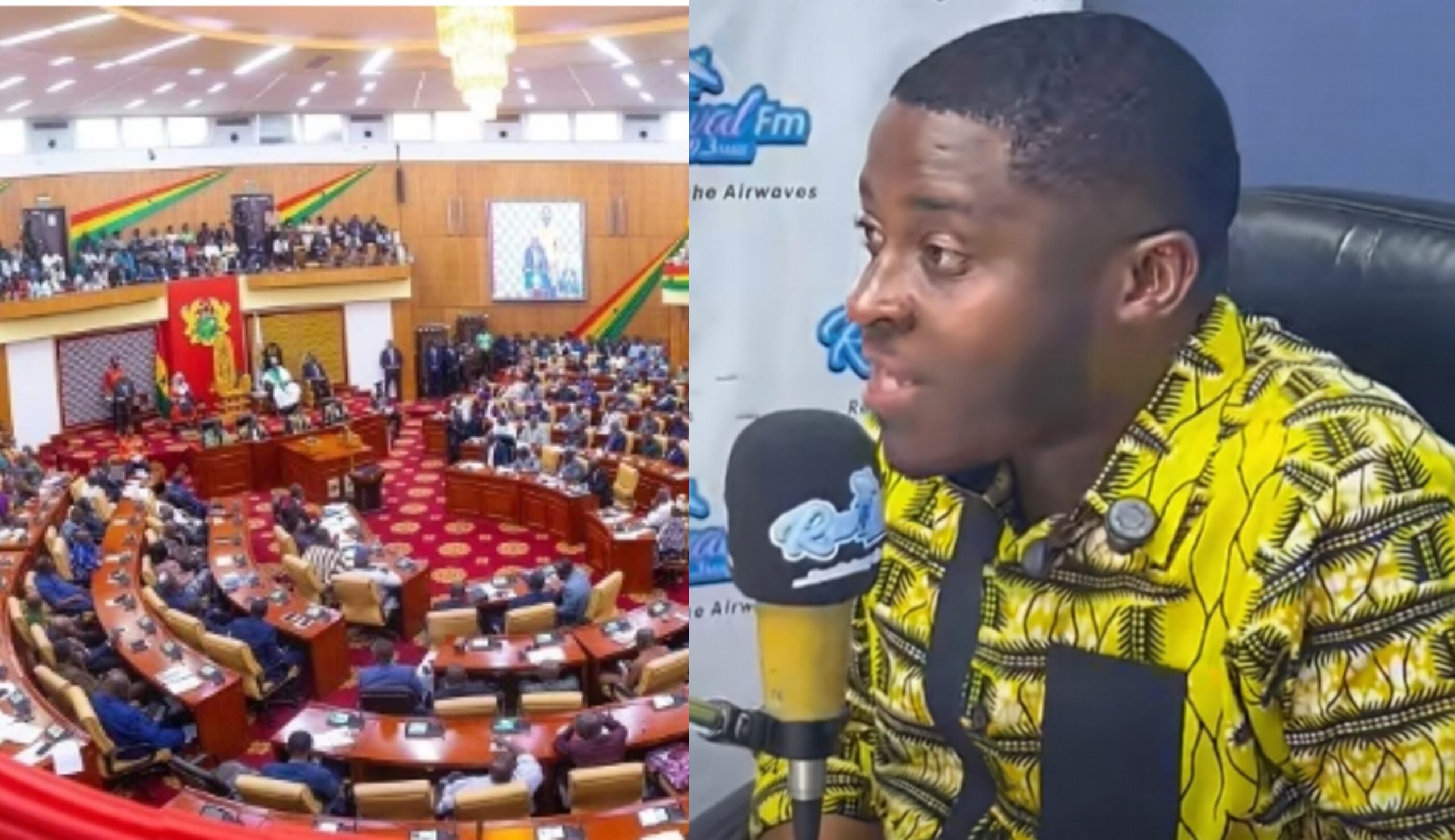
Can a Member of Parliament spend eight years in Ghana’s Parliament without speaking once on the floor of the House? According to Ketu North MP Eric Edem Agbana, it is possible.
Agbana has offered an insight into how parliamentary seniority, party arrangements and the limited time available for debates can make it difficult for some MPs, particularly first-term legislators, to secure speaking opportunities.
Kwaku Asare Challenges Rising Political Filing Fees: ‘Are We Electing Leaders or Raising Revenue?’
Speaking on Tadzewu-based Revival FM, he described the experience of junior MPs, the influence of parliamentary leadership on who gets to speak and measures introduced to give backbenchers more opportunities to contribute.
What Does It Mean to Be a Backbencher in Ghana’s Parliament?
Agbana explained that first-term and second-term MPs are generally classified as backbenchers, with newly elected legislators occupying the most junior position in the parliamentary hierarchy.
“Both first and second-timers are called backbenchers, meaning we the first-timers are the backbenchers of the backbenchers,” he said.
The distinction is important because parliamentary seniority can influence how visible and active an MP is during proceedings.
Agbana said junior MPs are often less visible during major parliamentary events, including the presentation of the national budget and the State of the Nation Address, when most members of the House are present.
“The only time you see us in front is when the majority of our seniors are not present and the chamber is looking empty,” he said.
However, the term backbencher has a specific meaning under Parliament’s Standing Orders. Order 6 defines a backbencher as a Member who has served no more than two parliamentary terms and is not a Minister of State or part of the leadership of the House or a committee.
During parliamentary proceedings on October 22, 2025, Ho West MP Emmanuel Kwasi Bedzrah clarified that the definition also provides an exception for the Chairperson or Ranking Member of the Backbenchers’ Committee. He stressed that backbenchers are not limited to first-term MPs; legislators serving a second term may also fall within the classification.
The classification is therefore based on parliamentary tenure and the positions a member holds, rather than simply where the MP sits in the chamber.
Why Is It Difficult for First-Term MPs to Speak in Parliament?
According to Agbana, the challenge is partly rooted in the way parliamentary business is organised and how speaking opportunities are allocated.
He explained that party leadership may select only a limited number of MPs to speak on behalf of their respective sides during debates. When a senior MP and a backbencher both seek to contribute, the senior member may be given priority.
“Sometimes, each side is only entitled to elect two or three people to speak on their behalf on matters, and if there’s a debate on the floor of Parliament and a backbencher and a senior rise to contribute, the Speaker would definitely prioritise the senior over the junior,” he said.
The result, he suggested, is that a first-term MP may have to wait for an opportunity to contribute, even when the subject under discussion falls within the member’s area of interest or expertise.
The issue is not necessarily that junior MPs are excluded from parliamentary business altogether. Rather, their opportunities to make contributions during plenary debates may be limited by the number of speakers selected, the time available and the seniority of other members seeking the floor.
How Some MPs Earn Opportunities to Speak
Agbana also pointed to examples of MPs who have earned greater recognition and speaking opportunities by demonstrating knowledge and expertise in particular subject areas.
He cited the experience of Atta Issah, who, according to him, became a prominent voice on financial matters after making a strong contribution.
He also mentioned Professor Titus Beyuo, whose contribution to discussions about the no-bed syndrome at Korle-Bu Teaching Hospital attracted public attention and helped establish him as a recognised voice on health-related issues.
Describing how one MP built that reputation, Agbana said:
“After all efforts, when he got the opportunity to speak once, he delivered exceptionally, and his contributions at caucus level on deliberations on such matters have made him the favourite,” he said.
The examples suggest that while parliamentary seniority can influence who gets to speak, a member’s knowledge and ability to make useful contributions can also help create opportunities.
Can an MP Spend Eight Years in Parliament Without Speaking?
Agbana acknowledged that it is possible for an MP to complete two parliamentary terms without making a contribution on the floor of the House.
He stressed, however, that the circumstances may differ. Some MPs may not be particularly interested in speaking during plenary sessions, while others may want to contribute but struggle to secure an opportunity.
“So when it is said that someone has been in Parliament but has never spoken on the floor, it is possible. Some people might not even get the chance to speak for a whole eight years because the opportunity is not there,” he said.
His explanation raises an important distinction in assessing parliamentary performance: the absence of a recorded floor contribution does not, on its own, establish that an MP has been inactive or has made no contribution to the work of Parliament.
Members also perform duties through committee meetings, scrutiny of legislation, oversight activities, party caucus deliberations and engagement with constituents. These activities do not necessarily translate into speeches during plenary sittings.
What Do Parliamentary Reports Reveal About MPs’ Work Beyond Speeches?
Recent parliamentary reports provide useful context for understanding why floor speeches are only one part of an MP’s work.
A Ghana News Agency report on the first meeting of the first session of the Ninth Parliament, which ran from January 7 to March 29, 2025, recorded 43 sittings over 11 weeks. During that period, MPs asked 52 questions that were answered by ministers, made 94 statements on issues of public importance and held 73 committee meetings. The House also considered 18 Bills, 16 of which were passed.
A separate Parliamentary Network Africa assessment examined the Ninth Parliament’s first 500 days. It recorded 155 plenary sittings, more than 717 hours of chamber business and approximately 350 committee meetings involving the House’s 44 committees. The report also identified 295 committee referrals awaiting reports and found that public memoranda were invited for fewer than 15 per cent of Bills passed during the period.
The two reports cover different periods and should not be treated as a single set of figures. Together, however, they illustrate the range of work undertaken by Parliament beyond individual speeches.
Importantly, these figures do not establish how frequently particular MPs spoke, how many opportunities each member received or whether a specific backbencher was prevented from contributing.
That distinction matters. Parliamentary activity reports provide an overview of the House’s workload, but determining an individual MP’s participation requires a closer examination of that member’s contributions in plenary, committee work and other parliamentary activities.
New Parliamentary Provision Gives Backbenchers a Monthly Speaking Opportunity
Agbana said the introduction of a dedicated period for backbenchers under Parliament’s revised Standing Orders was intended to address some of the challenges faced by junior legislators.
Under Order 73, Parliament is required to allot one hour on the last Wednesday of each month for the consideration of determined business for backbenchers.
The provision allows eligible MPs to make statements, present petitions, move motions and initiate Private Members’ Bills through the designated backbenchers’ business process.
However, the arrangement has faced implementation concerns.
On October 22, 2025, Tema Central MP Charles Forson, who chairs the Committee on Backbenchers’ Business, drew the House’s attention to the monthly provision and the need to operationalise it fully. During the same proceedings, Effia MP Isaac Boamah-Nyarko said the designated time had not been consistently observed.
Agbana acknowledged that the time allocated remains limited considering the number of MPs who may want to contribute.
“We are many, and the one hour is such a short time, but at least, it gives us the opportunity to be heard once in a month,” he said.
The provision therefore creates a formal opportunity for backbenchers, although its effectiveness depends on the regular scheduling and proper organisation of the business set aside for them.
Should Constituents Judge First-Term MPs Differently?
Agbana appealed to constituents to exercise patience when assessing newly elected MPs, arguing that first-term legislators need time to understand parliamentary procedures, establish themselves and gain the experience required to participate more effectively.
He said the benefit of the doubt should particularly apply to first-term MPs, while those serving a third term should be expected to have developed greater experience and confidence in the House.
“It always get better as you progress; that is why I always advise people that to weigh an MP’s strength fairly, give him the benefit of the doubt in the first term until he or she gets to the second term through to the third term,” he said.
He also appealed to constituents of the six backbench MPs in the Volta Region to recognise the work legislators undertake on behalf of their constituencies, even when that work is not always visible during parliamentary debates.
“Sometimes, they don’t sleep. They are always fighting for their constituencies, and although it’s not easy, we continue to press hard,” he said.
Agbana’s explanation highlights the difficulty of assessing an MP’s performance solely by the number of times the member speaks in Parliament. Speaking on the floor remains an important part of an MP’s responsibility, but it is not the only measure of legislative contribution.
For constituents, a more complete assessment should also consider participation in parliamentary scrutiny, committee work, engagement with government institutions and efforts to address the concerns of their communities. An MP’s silence during plenary debates may deserve scrutiny, but it should also prompt questions about the opportunities available to that member and the work being done beyond the chamber floor.