


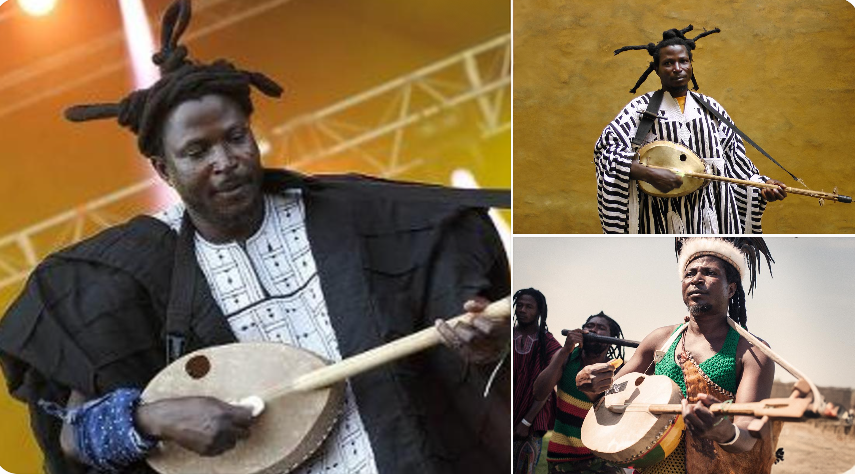
In April 2017, King Ayisoba spoke about an ambition that went beyond becoming an internationally recognised musician.
“I want to make the world love kologo music like Bob Marley made the world like reggae music,” he told Rhythm Passport.
Nearly a decade later, his Grammy nomination for No Tradition, No Africa, a collaboration with Rocky Dawuni, has brought that ambition into sharper focus.
The nomination has also drawn attention to the instrument at the centre of his music. The kologo has been played in northern Ghana for generations, and although Ayisoba has helped introduce its sound to international audiences, he is part of a much wider musical tradition.
The Two Strings Behind the Sound
The kologo is a traditional two-stringed lute associated with northern Ghana, particularly Frafra musical traditions in the Upper East Region.
Its construction is distinctive. A hollow calabash serves as the body, with goatskin stretched across it to create a resonating surface. Two strings run along a wooden neck, producing a sound that can be both rhythmic and melodic.
The musician plucks or strums the strings, often singing alongside the instrument. The combination gives kologo music its recognisable character, with strong rhythms and vocals that can move between storytelling, social commentary and entertainment.
Its appeal is not simply in how it sounds. The instrument has long been part of musical life in northern communities, featuring in performances at local drinking spots, markets, weddings, funerals and festivals.
For musicians, it offers a way to tell stories, express opinions and connect with audiences through familiar experiences.
The Musicians Who Took Kologo Beyond the North
King Ayisoba may be the name most readily associated with kologo music internationally today, but other performers helped bring the instrument to wider audiences before his breakthrough.
One of them was Captain Yaba, whose real name was Azongo Nyaaba. A historical account published by Northernghana.net, drawing on the writings and research of musicologist John Collins, describes him as one of the first Frafra kologo players to take the instrument from Bolgatanga into Ghana’s mainstream music scene.
Captain Yaba moved to Accra in the 1980s, joined jazz groups and performed at some of the city’s leading hotels. He recorded albums in 1989 and 1990 before touring internationally during the growth of the world music scene. He died in Accra in 2001.
Atongo Zimba followed a different path, but his music also helped carry the instrument beyond Ghana.
He learnt to make and play the kologo from his grandfather, who was also an instrument maker. In a 2024 interview with MyJoyOnline, Zimba recalled how the instrument became his signature and eventually took him across Africa.
“This instrument is my signature. This is my ‘passport’. This is what I took around Africa with no passport,” he said.
His career brought together traditional northern Ghanaian music and influences from other styles, including Afrobeat and jazz. He also performed at Fela Kuti’s Afrika Shrine in Nigeria before building an international career of his own.
Their stories show that Ayisoba inherited a tradition that had already begun travelling beyond its original communities.
A Musical Movement, Not a One-Man Story
The kologo’s wider following became particularly visible in 2016 with the release of This Is Kologo Power!, a compilation of recordings from Bolgatanga.
Released through Makkum Records, Red Wig and Sahel Sounds, the collection featured musicians including Ayuune Sule, Agongo, Prince Buju, Atimbila, Atamina, Amoru, Barnasko and Asaa Naho. King Ayisoba also featured on Atamina’s track, Africa Problem.
The recordings offered different expressions of the music. Some were sung in Frafra, others in Pidgin English. Some featured live bands, while others relied on the kologo and the singer alone.
The collection’s organisers deliberately avoided computer-generated beats, allowing the instrument and the performers to carry the music.
For listeners outside Ghana, it offered an introduction to a group of musicians whose work was not always represented in the country’s more commercially dominant music scene.
How King Ayisoba Took the Sound Further
Ayisoba’s contribution has been his ability to bring the kologo into contemporary music without losing its identity.
His debut album, Modern Ghanaians, released in 2006, introduced a sound that stood apart from much of Ghana’s mainstream music. Its popular song, I Want to See You My Father, helped establish him nationally and earned him recognition at the 2007 Ghana Music Awards, including Most Popular Song of the Year.
He continued to experiment with production and musical influences while keeping the kologo at the centre of his work.
His collaboration with Dutch musician and producer Frank de Boer, known professionally as Zea, helped open up opportunities for international touring and recording. The relationship contributed to releases including 1000 Can Die in 2017 and Work Hard in 2023.
Ayisoba’s music combines the traditional instrument with contemporary beats, percussion and different vocal styles. The result has introduced the kologo to listeners who might never have encountered it through its traditional settings.
A Grammy Nomination Years in the Making
Ayisoba’s collaboration with Rocky Dawuni on No Tradition, No Africa brings together two musicians with distinct but complementary approaches to African music.
Produced by Panji Anoff and released in May 2026, the song combines Ayisoba’s kologo sound with Dawuni’s Afro-roots influences. Its themes include African identity, cultural heritage and the importance of preserving traditions.
The recording earned a nomination in the Best African Music Performance category at the 2027 Grammy Awards, giving Ayisoba his first Grammy nomination.
It does not mean kologo music has achieved the worldwide popularity of reggae, the ambition Ayisoba expressed in 2017. But it gives the instrument visibility on a major international platform and introduces its sound to another audience.
The moment also reflects the work of musicians who helped keep the tradition alive and take it beyond northern Ghana, from Captain Yaba and Atongo Zimba to the performers featured on This Is Kologo Power!.
Ayisoba wanted the world to love kologo music. His Grammy nomination is not the fulfilment of that ambition, but it is a significant step towards making more people listen.

