


President John Dramani Mahama wants schoolchildren from Cape Coast in Ghana and Speightstown in Barbados to study in each other’s schools, turning a shared history shaped by the transatlantic slave trade into a practical educational partnership.
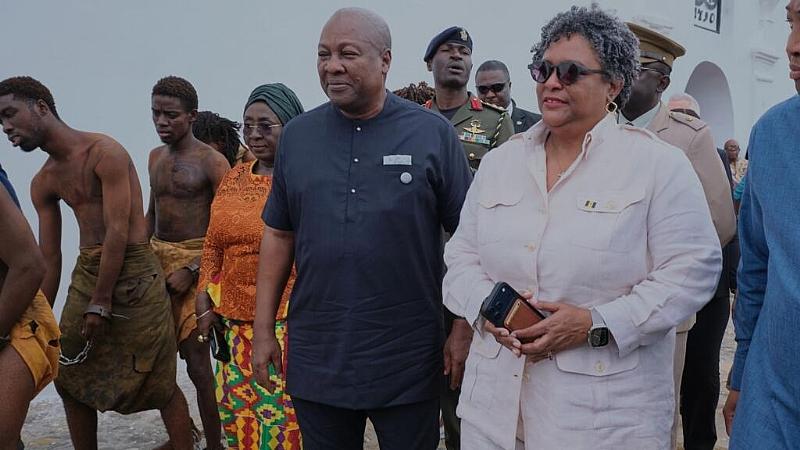
He made the proposal on November 27, 2026, when the two coastal communities formalised a twinning agreement at a ceremony in Speightstown, Barbados, attended by Mahama and Prime Minister Mia Amor Mottley.
“I’d like to see children of Cape Coast come and study in school with our little schoolchildren here, and schoolchildren of Speightstown come to Cape Coast and study with their brothers and sisters in Ghana,” Mahama said.
Mottley backed the proposal, making a public commitment on behalf of Barbados.
“President Mahama spoke of the importance of the exchanges of our school children, and we commit to that,” she said.
The endorsement gives the agreement a clear educational ambition. But the next challenge is to turn the leaders’ words into an organised programme that benefits pupils, teachers and the wider communities.
From Shared History to the Classroom
The connection between Cape Coast and Speightstown is rooted in the transatlantic slave trade.
Cape Coast was a major centre of the trade on the Gold Coast, from where enslaved Africans were forcibly transported across the Atlantic. Speightstown, historically known as Little Bristol, was among the early ports where enslaved Africans arrived in Barbados.
The ceremony also honoured King Cuffee, an Akan elder from the Gold Coast associated with a planned uprising against enslavement in Barbados in 1675. The uprising was betrayed before it could take place.
For Mahama, the twinning agreement should make the historical connection meaningful to a new generation, rather than leave it as a matter of monuments and remembrance.
He described the partnership as an opportunity for cooperation in education, culture, historical preservation, tourism and community development. He also urged the local authorities to sustain engagement and organise regular exchanges.
“I urge the local authorities of Cape Coast and Speightstown to give practical meaning to this agreement through sustained engagement, concrete initiatives and regular exchanges,” he said.
That is an important part of the proposal. The agreement will have limited impact if it produces ceremonies but no lasting contact between the people it is intended to bring together.
The Groundwork Has Already Begun
The idea of closer educational cooperation was discussed before the formal twinning ceremony.
In June 2025, Barbados’ High Commissioner to Ghana, Juliette Bynoe-Sutherland, visited the Central Regional Co-ordinating Council to discuss the proposed relationship between Speightstown and Cape Coast.
The discussions covered possible areas of collaboration, including cultural exchanges, law and medical student programmes and other developmental partnerships.
Dr James Conduah Orleans-Lindsay, Chancellor of Cape Coast Technical University, also took part in the engagement and highlighted the potential benefits for educational and professional development.
The earlier discussions provide a foundation for the new agreement. However, the school exchanges proposed by Mahama and endorsed by Mottley still need a defined implementation plan.
Neither leader announced participating schools, the number of pupils involved, a start date or how the exchanges would be funded.
What Would Make the Exchanges Work?
The two communities do not necessarily have to begin with large groups of pupils travelling between Ghana and Barbados.
Schools could first establish partnerships through virtual classroom sessions, joint history projects, cultural presentations and collaborative assignments. Pupils could learn about the history of both communities, discuss their cultural connections and work together on subjects relevant to their societies.
Physical exchanges could follow once the schools and authorities have agreed on the arrangements and secured funding.
The programme could also include teachers, allowing them to share teaching methods, resources and experiences. Beyond history, pupils could explore literature, music, geography, environmental issues and entrepreneurship.
But access will matter. International travel, accommodation, supervision, insurance and other costs could make the opportunity available only to a small group of children unless the programme has a sustainable funding arrangement.
The Ghanaian and Barbadian governments, local authorities, educational institutions and private-sector organisations could explore ways to support it. Diaspora organisations and cultural institutions may also be able to contribute.
The local authorities will be central to this process. They need to identify participating schools, agree on responsibilities and establish a timetable for the exchanges.
There should also be a way to measure progress, including the number of schools and pupils involved, exchanges completed and joint projects sustained.
More Than a Ceremony
The twinning agreement is part of wider efforts to strengthen links between Africa and the Caribbean. Mahama cited Ghana’s Year of Return, Beyond the Return and Black Star Experience as initiatives intended to reconnect the country with the global African family.
But the school-exchange proposal offers a more immediate way for residents of Cape Coast and Speightstown to experience that relationship.
For Ghanaian pupils, it could provide an opportunity to understand the Caribbean beyond what they learn in history lessons. For Barbadian children, it could create a closer connection with Ghana and the African continent.
Mahama offered a fitting warning about the difference between commemorating history and keeping its lessons alive.
“Bronze may preserve King Cuffee’s image, but our actions must sustain his ideals,” he said.
The success of the partnership will depend on what follows the ceremony: whether schools are paired, resources secured and pupils given opportunities to learn from one another.
Mottley has publicly committed Barbados to the exchanges. Both sides must now show how they intend to deliver them.
The history connecting the two towns was shaped by forced separation. Their new partnership offers an opportunity for the next generation to build a relationship through education, shared experience and choice.

