


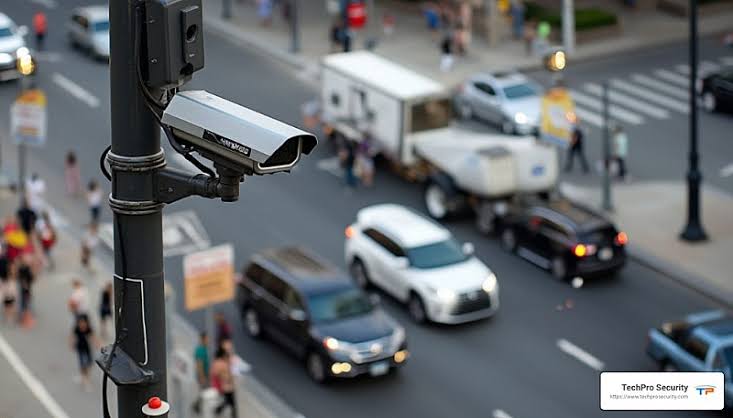
Ghana’s new automated traffic enforcement system is intended to make drivers more accountable for road offences. But a reported case involving a GH¢240 speeding ticket sent to someone who says he neither owned nor drove the vehicle has raised questions about the accuracy of the records behind the system.
The incident was detailed by Sitsofe Mensah, a technology associate with IMANI Africa, in an opinion article published by MyJoyOnline on November 26, 2026.
According to Mensah, a commercial minivan travelling at 85 kilometres per hour in a 50km/h zone was captured by a speed camera on a northern highway at 2:26 p.m. on November 24.
The vehicle received a GH¢240 speeding ticket through the Ghana Police Service’s TraffiTech-GH system. However, the electronic notice was reportedly sent to a man who had never owned the minivan, was not driving it and was nowhere near the location.
Mensah said the recipient opened the accompanying link and found another person’s name, telephone number, vehicle registration and details of the alleged offence.
The case raises questions about whether the system can correctly identify vehicle owners and protect the personal information attached to its notices.
How TraffiTech-GH Is Supposed to Work
TraffiTech-GH is an automated traffic enforcement system introduced by the Ghana Police Service to detect road traffic offences using cameras and sensors.
It became operational on November 1, 2026, initially focusing on speeding and other camera-detected violations.
When an offence is captured, an Electronic Notice of Violation (ENV) is issued. The notice provides details of the alleged offence, including the vehicle registration, location, date, time and amount payable.
The system is intended to improve compliance and reduce reliance on roadside enforcement. Its effectiveness, however, depends on more than accurate cameras. The records used to identify vehicle owners and deliver notices must also be reliable.
Police Have Acknowledged That Tickets Can Reach the Wrong Numbers
The possibility of incorrect notifications was acknowledged before the system became operational.
ACP Alexander Kwaku Obeng, Director of Research, Education and Training at the MTTD, told Channel One News on October 31 that a ticket could be sent to a telephone number that did not belong to the vehicle owner.
“It can be possible that the ticket would have been sent to a number that doesn’t own the vehicle,” he said.
He explained that motorists could examine the evidence, including video footage of the alleged offence, and challenge a ticket they believed was incorrect.
In a November 6 statement reported by the Ghana News Agency, Commissioner of Police Grace Ansah-Akrofi, Director-General of Public Affairs, also urged motorists to verify the details on their notices.
“They should also open the Electronic Notice of Violation (ENV) or ticket to verify the vehicle’s photograph and registration number,” she said.
What Should Motorists Do If They Receive the Wrong Ticket?
Under the Police’s published procedures, motorists have 14 days from the date of an Electronic Notice of Violation to pay or begin the process of challenging it.
Recipients should check the vehicle photograph, registration number, location, date and time of the alleged offence. They should also examine any available video evidence.
Those disputing a ticket can begin the contest process online, selecting a preferred MTTD regional police station and a date for a hearing.
Anyone who receives a notice for a vehicle they have never owned is advised to contact the TraffiTech-GH call centre immediately.
The Police’s published guidance states that a late-payment penalty of one per cent of the original fine applies for each day of default after the 14-day period.
How Accurate Are Ghana’s Vehicle Records?
The reported incident also raises questions about the accuracy of the information used to deliver electronic notices.
The Driver and Vehicle Licensing Authority (DVLA) maintains vehicle registration and ownership records, which are important to the identification process.
In his MyJoyOnline article, Mensah raised concerns about the verification and updating of telephone numbers linked to vehicle records. Outdated contact details and recycled telephone numbers could potentially result in notices reaching people who are no longer associated with a vehicle.
These are possible explanations, not established causes of the incident. Determining what went wrong would require an examination of the relevant records and an explanation from the agencies involved.
The Ghana Police Service and the DVLA should therefore clarify whether the case reflects an isolated error or a wider weakness in the information used by the system.
What About the Personal Information Exposed?
There is also a data protection concern.
Mensah said the recipient of the incorrect notice was able to access another person’s name, telephone number and vehicle details through the accompanying link.
If confirmed, this raises questions about the safeguards governing access to information held by the Police and the DVLA.
Ghana’s Data Protection Act, 2012 (Act 843), provides a framework for protecting personal information. A traffic enforcement system should ensure that such information is accessible only to people with a legitimate reason to view it.
It is not yet established whether the Data Protection Commission has received a formal complaint about the incident.
Can Motorists Trust the System?
Automated enforcement could improve road safety by helping the Police detect offences and apply traffic regulations consistently.
But public confidence will depend on whether the system identifies the correct vehicles, sends notices to the appropriate people and provides a fair process for correcting mistakes.
The reported case deserves an explanation from the Police and the DVLA. If it is an isolated error, the agencies should establish how it happened and prevent a recurrence. If similar cases are emerging, the accuracy of the underlying records and the system’s verification procedures may need a broader review.
Ghana needs a traffic enforcement system that holds drivers accountable for dangerous behaviour. It must also ensure that innocent motorists are not made to answer for offences they did not commit.

