
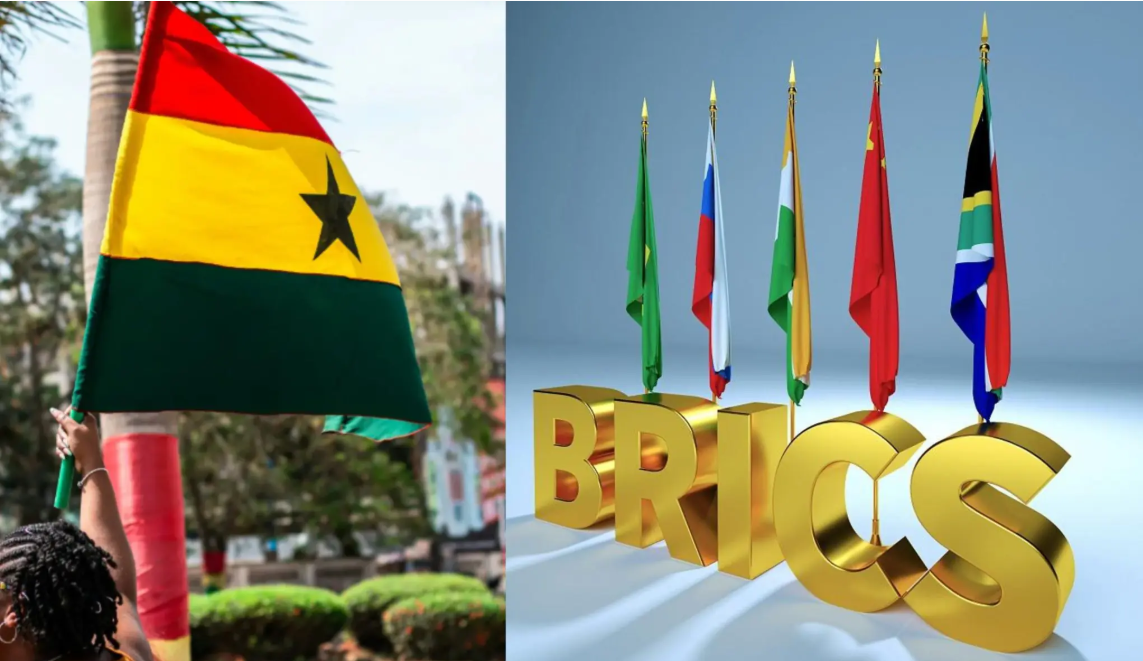
Ghana wants to join BRICS, the grouping of major emerging economies, in a move the government says will give the country more options for trade, investment and development.
Cabinet approved the decision on Tuesday, October 6, with Foreign Affairs Minister Samuel Okudzeto Ablakwa saying Ghana was preparing to submit its formal application and would seek the backing of existing members.
For Ghana, however, the interesting part is not simply becoming a member of another international grouping. It is what Accra can get out of the relationship.
The government is looking for investment, industrialisation and greater value from Ghana’s natural resources. Whether BRICS can help deliver those things will depend largely on how Ghana uses the opportunity.
Why Ghana Wants To Join BRICS
Ablakwa says the decision is about giving Ghana more choices.
Ghana already works with the IMF, World Bank and African development institutions, and the minister stressed that joining BRICS would not mean abandoning those relationships.
“BRICS offers us that opportunity to have options in development, and you want to have options,” he said.
He was equally clear about the government’s intention to keep its existing partnerships.
“We are not going to walk away from our traditional partners who value that relationship, but we must have new friends,” Ablakwa said.
That approach matters because BRICS brings Ghana closer to countries such as China, India, Brazil and Russia without requiring Accra to end its existing relationships with Western countries or international financial institutions.
The government is also making the case in economic terms.
Ablakwa said Ghana wanted partners that could help it move beyond exporting raw materials and do more processing and manufacturing at home.
“We don’t want a situation where we continue to export raw materials. We want to add value to the natural resources that we have,” he said.
That is where the proposed membership could become significant for Ghana.
Ghana Already Trades With BRICS Countries
Ghana does not need BRICS membership to start doing business with its members.
It already has substantial economic relationships with several of them.
Ghana Statistical Service data for the second quarter of 2025 showed South Africa accounting for 9.0 per cent of Ghana’s export revenue, India 7.9 per cent and China 6.3 per cent.
China was also Ghana’s biggest source of imports during the quarter, accounting for 22.7 per cent, while India accounted for 6.4 per cent.
Ablakwa also pointed to the growth in Ghana’s trade with India, saying it had risen from about US$3 billion in 2024 to approximately US$7 billion.
The question, therefore, is not whether Ghana can trade with BRICS countries. It already does.
The question is whether those relationships can produce more investment, more local production and more exports of finished or semi-finished goods.
The Opportunity For Ghana
One obvious attraction is access to large and growing markets.
BRICS includes China and India, two of the world’s most important economies, as well as Brazil, the UAE and other major emerging markets.
For Ghanaian businesses, deeper relationships could open opportunities in areas such as agriculture, manufacturing, pharmaceuticals, mining, technology and infrastructure.
Ghana is also pursuing ways to make cross-border commerce easier within Africa, including a digital trade corridor with Rwanda and Zambia.
But more trade is not necessarily better trade.
If Ghana simply imports more finished goods from BRICS countries, the increase in trade may do little to address the country’s underlying production problems.
The more useful outcome would be investment that leaves something behind: a processing plant, a manufacturing operation, new technology, skills, jobs or a Ghanaian company able to compete in regional and international markets.
That is particularly relevant to Ghana’s long-standing effort to add value to commodities before exporting them. Ghana’s push to keep more value from its gold industry at home is part of a wider African trend towards domestic refining and processing.
Africa’s Gold Refining Shift: Countries Moving To Keep More Value At Home
What About The New Development Bank?
The New Development Bank is one of the institutions associated with BRICS and provides financing for infrastructure and sustainable development projects in emerging and developing economies.
That could make it relevant to Ghana, particularly given the country’s infrastructure and development financing needs.
But Ghana should not be presented as automatically gaining access to the bank simply by joining BRICS.
The NDB has its own membership arrangements, and Ghana is not currently listed among its members.
So any attempt by Ghana to use the bank as an additional source of development finance would be a separate matter.
There Is A Diplomatic Benefit Too
BRICS is also about more than trade and finance.
The grouping has become an important forum for countries that want greater influence for emerging and developing economies in global institutions.
For Ghana, membership could provide another platform from which to engage major powers and argue for reforms to the international system.
Ablakwa has described the government’s approach as one of widening Ghana’s international partnerships rather than choosing one side over another.
That may prove useful at a time when competition between major powers is increasingly shaping trade, technology, finance and international diplomacy.
But There Are Risks
The first is diplomatic.
BRICS is not a group of countries that agree on everything. Its members have different political systems, foreign policy priorities and relationships with the United States and Europe.
China and Russia, for example, have particularly difficult relationships with Washington, while India maintains important strategic and economic ties with both the United States and Russia.
Ghana would therefore have to be careful about how far it aligns itself with positions taken collectively by the grouping.
India’s External Affairs Minister, Subrahmanyam Jaishankar, offered support for Ghana’s interest in BRICS during his visit to Accra, but also made clear that the application would have to be considered by the group as a whole.
“Obviously, this is an issue of collective consideration. So we have to see how that goes forward,” he said.
That is an important qualification.
India’s support is useful to Ghana, but it does not determine whether the country will be admitted.
Could It Create Problems With The United States?
There is another consideration for Accra.
US President Donald Trump has previously threatened tariffs against BRICS countries over efforts to reduce the dominance of the US dollar and has warned countries against aligning themselves with what he called the “Anti-American policies” of BRICS.
Those warnings were not aimed specifically at Ghana.
Nor does joining BRICS automatically mean Ghana would become an opponent of the United States.
But the threats show the kind of geopolitical pressure that can accompany a more assertive BRICS.
Ghana would have to manage that carefully, particularly because the United States remains an important economic and diplomatic partner.
Ghana Could Also Get The Relationship Wrong
There is a more basic economic risk.
Joining BRICS will not make Ghana less dependent on foreign capital simply because the capital comes from a different group of countries.
If Ghana becomes heavily dependent on a small number of BRICS countries for loans, infrastructure contracts, imports or investment, the country could end up with a different form of dependence rather than greater economic independence.
The terms of the individual deals will therefore matter far more than the BRICS label attached to them.
A good investment is still a good investment whether it comes from a BRICS country or a Western country.
The same applies to a bad deal.
It Will Not Fix Ghana’s Economic Problems
There is also a danger of expecting too much from membership.
BRICS cannot, on its own, fix Ghana’s debt problems, create jobs, strengthen the cedi or build an industrial base.
Those things will still depend on decisions taken in Accra: the quality of economic policy, the business environment, infrastructure, energy supply, taxation, skills and the ability of Ghanaian companies to compete.
Membership can create opportunities. It cannot guarantee the outcome.
What Happens Next?
Ghana’s immediate task is to submit its formal application and lobby existing BRICS members for support.
The group’s rules require an interested country to formally express its intention to join. The application then goes through the BRICS process before a final decision is taken by the leaders.
BRICS decisions on admitting new members are made by consensus.
India is chairing BRICS in 2026, giving Ghana an important diplomatic partner as it begins the process.
But there is no guarantee of admission yet.
So, What Would BRICS Actually Do For Ghana?
The answer will depend less on the membership itself than on what Ghana negotiates afterwards.
Ghana already has access to many of the countries in BRICS through bilateral trade and diplomatic relationships. Membership could make those relationships easier to coordinate and give Ghana another platform for pursuing its economic interests.
But the real prize would be productive investment.
If Ghana can use its relationships with BRICS countries to process more of its gold, cocoa and other natural resources, manufacture more goods locally, attract technology and create jobs, the decision could prove worthwhile.
If it mainly results in more imported goods and new sources of external borrowing, the benefits will be much harder to see.
That is why the most important part of Ghana’s BRICS strategy will begin after the diplomacy.
The question is not simply whether Ghana joins BRICS. It is what Ghana gets from joining.