


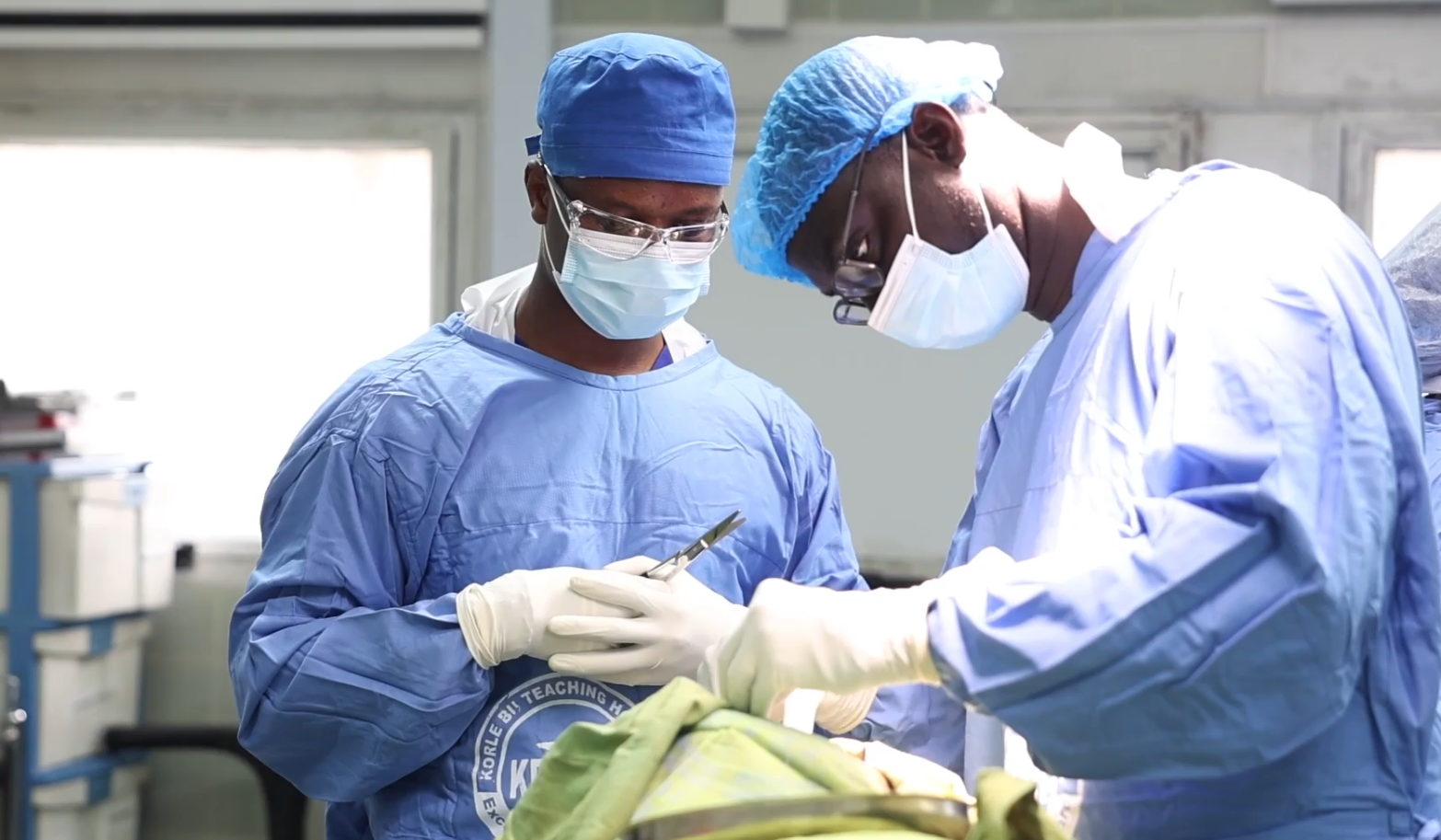
Surgeons at the Korle Bu Teaching Hospital have successfully reattached a man’s completely severed penis in a rare and complex operation, a significant achievement for the hospital’s Urology and Nephrology Centre.
The patient reportedly sustained the injury after slipping while attempting to sit on a water closet (WC), resulting in the severing of his penis.
Professor Titus Beyuo, Chairman of the hospital’s Board, disclosed the development during an interview on Channel One TV’s The Big Issue on Saturday, November 21, 2026.
He said the surgical team had successfully reattached the organ and that it was functioning.
“The good news is that our team of doctors has completely and successfully reattached it and it is functioning,” Professor Beyuo said.
He described the operation as particularly significant because of how rarely such cases occur.
“There are rare cases of this in the medical literature and I think it is something good to celebrate,” he added.
Although the outcome is encouraging, the hospital has not publicly disclosed details such as how long after the injury the patient received treatment or the specific techniques used during the operation.
Those details are important because successful reattachment involves more than reconnecting tissue. Surgeons must also restore blood circulation and preserve the organ’s functions.
How Can Surgeons Reattach a Completely Severed Penis?
The operation is medically known as penile replantation. It involves surgically reconnecting the severed portion to the remaining tissue, with the aim of restoring blood supply, urinary function and sensation, as well as erectile function where possible.
The procedure is technically demanding because the penis contains several structures that must be repaired, including blood vessels, nerves, the urethra and erectile tissues.
Surgeons may use microsurgical techniques, working under magnification to reconnect very small blood vessels and nerves. The urethra, which carries urine out of the body, must also be repaired.
The American Urological Association’s guidance on urotrauma recommends prompt replantation when appropriate and highlights the importance of repairing the organ’s major structures. It also recommends involving a microvascular surgeon where possible.
The exact approach depends on the nature of the injury, the condition of the severed tissue and the time that has passed before treatment.
Korle Bu has not yet released enough clinical information to establish which specific techniques its surgeons used in this case.
Why Time Matters After Such an Injury
A severed body part loses its blood supply, depriving the tissue of oxygen and nutrients. The longer it remains without adequate circulation, the greater the risk of tissue damage.
Penile amputation is therefore a medical emergency requiring immediate hospital attention.
The condition of the severed tissue and how it is preserved before surgery can influence the chances of successful reattachment.
Medical guidance recommends wrapping the severed portion in saline-moistened gauze, placing it in a sealed plastic bag and keeping it cool in a separate container containing ice. It should not be placed directly on ice because this can cause further tissue damage.
The priority is to get the injured person to a hospital as quickly as possible.
Does Successful Reattachment Mean All Functions Return?
Not necessarily.
Professor Beyuo’s description of the reattached organ as “functioning” is encouraging, but it does not establish whether the patient has regained all normal functions.
Restoring blood circulation is essential for the survival of the reattached tissue. However, urinary function, sensation and erectile function are separate outcomes that may take time to assess.
Medical literature documents complications following penile replantation, including tissue loss, reduced sensation, problems with blood circulation and urinary difficulties. Some patients may also experience sexual dysfunction or require further treatment.
The patient’s recovery will therefore need to be monitored beyond the initial operation.
Further information from Korle Bu would help clarify what the hospital means by restored function and how the patient is progressing.
Another Specialised Procedure at Korle Bu
The operation comes after another notable medical development at the teaching hospital involving a 14-year-old girl who received a replacement pulmonary valve without undergoing conventional open-chest surgery.
Specialists at Korle Bu’s National Cardiothoracic Centre reached her heart through a blood vessel in her thigh and implanted a Harmony Valve using a technique known as transcatheter pulmonary valve replacement.
The two procedures involve different medical specialities, but both highlight the complex interventions being undertaken by teams at the hospital.
Read how Korle Bu doctors reached a teenager’s heart through her thigh to replace a faulty valve.
For the man who underwent penile replantation, the immediate achievement is clear: surgeons successfully reattached the severed organ, which Professor Beyuo says is functioning. The longer-term outcome will depend on his recovery and whether its normal functions are restored.

