


Barbados’ decision to join Ghana’s reparatory justice campaign has strengthened the growing partnership between Africa and the Caribbean, but the real test will be whether their cooperation can turn international recognition of slavery’s historical crimes into practical measures for affected communities.
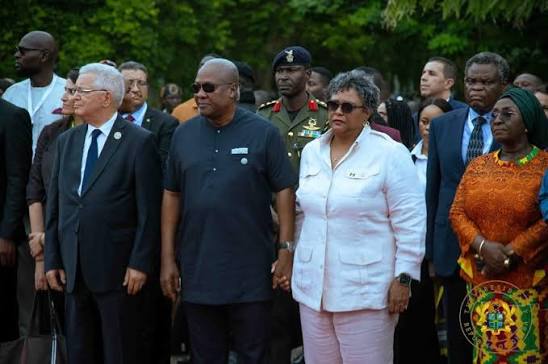
Prime Minister Mia Amor Mottley announced the decision during President John Dramani Mahama’s visit to Speightstown on November 27, confirming that Barbados had agreed to serve on Ghana’s Global Africa Commission on Reparatory Justice.
She praised Ghana for its role in securing international recognition of the transatlantic slave trade as the gravest crime against humanity, describing the country’s efforts as an act of “moral courage”.
“Earlier this year, Ghana exhibited a moral courage for which I would want to salute you now on Barbadian soil,” she told Mahama.
Mottley also made clear that the campaign should not be dismissed as an attempt to dwell on historical grievances.
“We do not seek to live in the past, but we also do not believe that injustice should prevail,” she said.
Her announcement comes at a critical moment. Ghana and its Caribbean partners have secured significant diplomatic support, but the difficult work of agreeing on what reparatory justice should deliver, and who should be responsible for it, lies ahead.
From UN Recognition to a Wider Reparations Campaign
Ghana’s campaign recorded a major diplomatic achievement on March 25, 2026, when the United Nations General Assembly adopted Resolution A/RES/80/250.
The resolution declared the trafficking of enslaved Africans and racialised chattel enslavement of Africans the gravest crime against humanity. It received 123 votes in favour, three against and 52 abstentions.
The vote gave international recognition to a central demand of African and Caribbean advocates: that the scale and consequences of the transatlantic slave trade must be confronted as a matter of historical responsibility and justice.
But the declaration did not establish a compensation scheme or compel countries to pay reparations. Its significance lies partly in providing a stronger diplomatic foundation for the discussions that must follow.
Mahama has argued that the campaign is about responsibility rather than inherited personal guilt.
“History does not ask us to inherit guilt, but it asks us to inherit responsibility,” he told delegates at a June reparatory justice conference in Accra, according to Reuters.
That distinction is important. The demands are directed at states and institutions that benefited from slavery and its consequences, rather than at individuals simply because of their nationality or ancestry.
Why Barbados’ Participation Matters
Barbados brings considerable experience to the reparations debate.
Through the Caribbean Community (CARICOM), the region has developed a Ten-Point Plan for Reparatory Justice, covering issues such as a formal apology, repatriation, education, public health, cultural preservation, technology transfer and debt cancellation.
The plan reflects the Caribbean’s position that reparatory justice must address the lasting economic, social and institutional consequences of slavery, rather than be reduced to a single financial payment.
In June 2026, African and Caribbean countries took another step towards coordinating their demands when a three-day conference in Ghana produced a 19-point reparations plan endorsed by the African Union and CARICOM Commission on Reparatory Justice.
The plan called for a Global Reparations Fund, debt relief and cancellation for affected countries, restitution of looted cultural property and ancestral remains, climate justice financing and reforms to international financial institutions.
It also addressed the specific violence inflicted on African women and girls during slavery and proposed pathways for diaspora Africans seeking to return to the continent.
The agreement brought together initiatives that had previously been pursued separately by African and Caribbean institutions.
Barbados’ participation in Ghana’s latest initiative could strengthen this cooperation and give the campaign a more coordinated voice in international discussions.
It is also consistent with Mottley’s position that reparatory justice should address the development challenges that continue to affect countries shaped by slavery and colonialism.
What Structures Has Ghana Put in Place?
Ghana has begun establishing institutions to support the next phase of the campaign.
At the June 2026 Next Steps Consultative Conference in Accra, Mahama announced three international panels:
- The Global Advisory Panel on Reparatory Justice.
- The Expert Panel on the Restitution of Cultural Artefacts.
- The Global Legal Panel on Reparatory Justice.
The Global Advisory Panel is intended to provide strategic guidance, while the cultural artefacts panel will support efforts to recover looted heritage. The legal panel is expected to explore possible legal pathways for advancing reparatory justice.
Ghana News Agency reported that Mottley was already among the leaders identified as members of the Global Advisory Panel.
However, her November 27 announcement referred specifically to the Global Africa Commission on Reparatory Justice. Ghana and Trinidad and Tobago have also been exploring a dedicated Africa-Caribbean mechanism to coordinate reparations discussions with Britain.
These are related efforts, but the available public announcements do not fully explain how the commission, the three panels and the proposed joint mechanism fit together.
That institutional clarity will matter. A campaign with several bodies must have defined responsibilities, clear membership and a practical programme of work if it is to avoid duplication.
The UK Dialogue Will Be a Major Test
One of the most important developments is the United Kingdom’s agreement to engage in structured discussions on the historical harms of the transatlantic slave trade.
At the Commonwealth Heads of Government Meeting in Antigua and Barbuda in November 2026, leaders welcomed the UK government’s commitment to a “structured, time-bound, inclusive and good-faith dialogue” with affected parties.
Ghana has been involved in discussions on how the process should be organised. A November 5 statement from the Ministry of Foreign Affairs said Foreign Affairs Minister Samuel Okudzeto Ablakwa had met UK Foreign Secretary Ed Miliband on November 2 to discuss arrangements for the proposed dialogue.
The discussions included the appointment of African and Caribbean co-chairs and a proposed 12-month process covering historical justice, education, cultural restitution, climate justice, debt sustainability and reform of the international financial architecture.
However, there is a significant difference between the positions of the two sides.
The UK government has expressed openness to dialogue and a possible formal apology, but has ruled out financial reparations. Caribbean leaders, meanwhile, have insisted that an apology alone would not satisfy their demands.
That disagreement could become one of the most difficult issues in the negotiations.
Mottley has urged that the discussions proceed in a “structured, dignified manner”. Her call reflects the need to maintain dialogue without abandoning the substance of the reparations campaign.
What Could the Partnership Deliver?
The value of Barbados’ participation will depend on whether it helps turn shared positions into practical cooperation.
There are several areas where the partnership could make a difference.
A stronger diplomatic voice: African and Caribbean countries could coordinate their positions more effectively in discussions with Britain and other countries whose institutions benefited from slavery. A common approach would give their demands greater weight.
Education and historical research: Joint research, educational programmes and exchanges could deepen understanding of the slave trade, colonialism and their continuing effects. They could also help preserve historical records and connect younger generations with their shared history.
Cultural restitution: The recovery of looted artefacts, archives and ancestral remains remains a central part of the campaign. African and Caribbean institutions could work together to identify cultural property and strengthen demands for its return.
Development and economic justice: The 19-point plan includes proposals on debt relief, climate financing and reform of international financial institutions. These demands connect historical responsibility with the economic challenges facing many African and Caribbean countries today.
These are possible areas of cooperation, not commitments that have already been funded or implemented. Their delivery will require agreed priorities, financing and measurable targets.
The Questions That Must Now Be Answered
Barbados’ announcement is significant, but the next steps need to be clearer.
What exactly will the Global Africa Commission on Reparatory Justice do? Who will serve on it? How will it relate to Ghana’s three global panels and the proposed Africa-Caribbean mechanism? What resources will support its work, and how will progress be measured?
There is also the challenge of maintaining a common position among countries that may not agree on every aspect of reparations.
The CARICOM Ten-Point Plan and the 19-point framework endorsed by African and Caribbean institutions provide a foundation. But negotiations with Britain will require agreement on which demands should take priority and how they can be pursued.
The UK’s refusal to consider financial reparations makes that task even more difficult.
For Ghana and Barbados, the challenge is to ensure that international recognition leads to more than declarations and diplomatic meetings. Progress should be visible in areas such as education, cultural restitution, historical preservation and development opportunities.
The two countries’ shared history gives their cooperation a special significance. But it is the practical outcomes of that cooperation, rather than the number of countries expressing support, that will determine how much the reparatory justice campaign achieves.
Barbados has now signalled its willingness to join Ghana’s effort. The responsibility is to turn that commitment into a clear, coordinated and lasting programme of action.

