


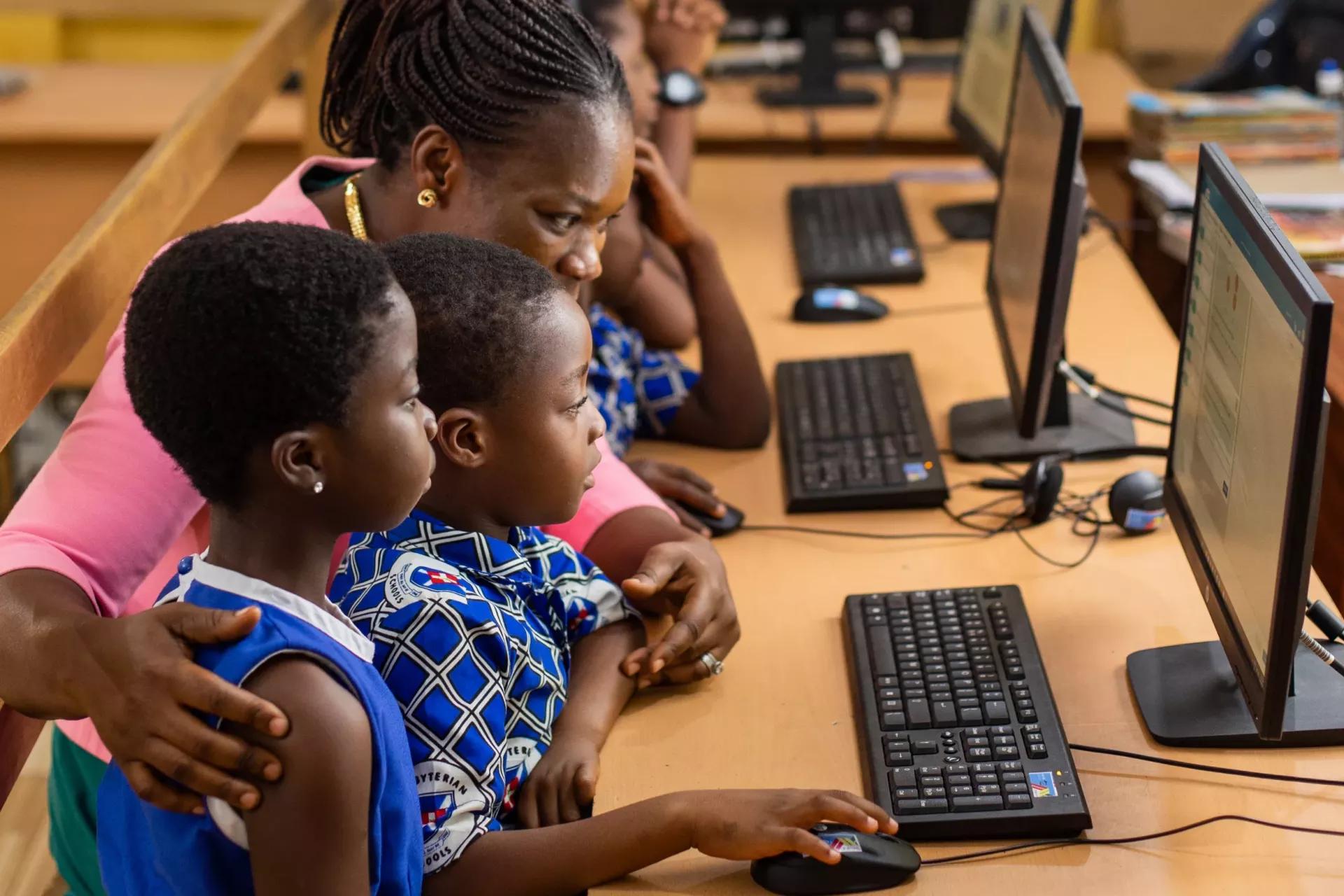
A child in a rural Ghanaian classroom and one in a well-equipped urban school are both expected to benefit from the government’s proposed introduction of artificial intelligence, robotics and coding into basic education. But before these subjects reach classrooms, Ghana must answer a difficult question: does the education system have the teachers, equipment and resources to make the plan work?
Education Minister Haruna Iddrisu announced on November 24 that the government plans to introduce robotics, coding, artificial intelligence (AI) and electronics into the curriculum for children from Kindergarten to Primary Six.
The proposal is intended to expose pupils to emerging technologies early and prepare them for a world in which digital skills are becoming increasingly important.
However, the revised curriculum has not yet received Cabinet approval. The minister did not announce an implementation date, meaning the proposed changes are not yet in force.
For Ghanaian parents and teachers, the announcement raises a bigger question than whether children should learn about technology: how will schools actually teach it?
What Will Children Learn?
The proposed changes form part of a wider revision of the Kindergarten to Primary Six curriculum by the National Council for Curriculum and Assessment (NaCCA).
When the Curriculum Review Committee presented its work to the Education Ministry in July, it outlined changes that went beyond adding technology-related subjects.
The revised curriculum included artificial intelligence literacy, computational thinking, coding, digital citizenship and civic education. It also proposed changes to language instruction, including the introduction of French from Basic One.
NaCCA Director-General Professor Samuel Ofori Bekoe said the review involved 160 writers and reviewers working across 12 subject areas between March and July 2026.
About 80 per cent of the existing curriculum was retained, with the remaining changes intended to address identified gaps and improve learning.
The committee’s work was prompted partly by concerns about foundational literacy and numeracy, as well as feedback from teachers who felt the existing curriculum was overloaded and fragmented.
That background matters. Ghana is not simply adding fashionable technology subjects to the timetable; it is attempting to reshape what children learn and how they learn it.
The Teacher Question Ghana Cannot Ignore
Introducing AI and robotics into basic education will require more than changing the curriculum document.
Teachers must understand the subjects themselves and know how to explain them to children at different stages of development. A Kindergarten pupil, for example, cannot be taught technology in the same way as a Primary Six learner.
The Curriculum Review Committee recognised this challenge. Among its recommendations were a phased, adequately resourced teacher-training programme and a monitoring and evaluation framework to assess how the revised curriculum performs.
President John Mahama has previously said teacher training is already accompanying the distribution of STEM equipment under the government’s Basic School STEM programme.
At the launch of the programme in Sawla in May, he disclosed that more than 5,000 schools had received STEM equipment, with plans to extend the rollout to others.
He said the aim was to make practical science education accessible beyond a small number of specialised schools.
“We want to decentralise STEM so that every Ghanaian child has the opportunity to learn science, technology, engineering, and mathematics in an easier manner than we have taught it in the past,” the President said.
The equipment rollout offers a foundation for the proposed reforms. But the government still needs to explain how many schools have the facilities required for the new curriculum, what additional resources will be provided and how teachers will be prepared to use them.
A school receiving STEM equipment does not automatically mean its teachers are ready to teach coding, robotics or artificial intelligence.
Will Rural Schools Be Left Behind?
The success of the proposal will also depend on whether children have a fair opportunity to benefit, regardless of where they attend school.
Schools with well-equipped computer laboratories, reliable electricity and access to trained teachers may find it easier to introduce practical technology lessons.
Others may struggle with basic infrastructure.
If the government does not address these differences, the introduction of advanced technology education could widen an existing divide between well-resourced schools and those with fewer facilities.
This is why the rollout needs to be properly funded and phased. Schools should not be expected to deliver the same curriculum without first receiving the resources and support needed to teach it.
The Education Ministry must also clarify whether the new subjects will be taught as separate lessons or integrated into existing subjects, and how pupils will be assessed.
These details will determine whether the proposal becomes meaningful classroom learning or another ambitious policy that is difficult to implement consistently.
Haruna Iddrisu Warns Against Lazy Learning
There is another challenge the government will have to confront: how to ensure children learn to use artificial intelligence without becoming dependent on it.
Iddrisu has cautioned that excessive reliance on AI could weaken pupils’ ability to think independently, solve problems and develop their creativity.
He was particularly concerned about children using the technology as a shortcut instead of engaging with their schoolwork.
“We are not going to replace teachers with AI,” he said, stressing that the government’s intention was to empower teachers with technology rather than replace them.
He also warned: “We need to guard against the use of AI in producing lazy learners from primary school up to the university.”
His concern highlights an important distinction. Teaching children about artificial intelligence should help them understand how technology works, assess the information it produces and use it responsibly. It should not encourage them to outsource their thinking.
That distinction will need to be reflected in the curriculum, teacher training and classroom rules governing the use of AI tools.
What Happens Next?
The revised curriculum must still complete the approval process before the proposed changes can be implemented.
The government will also need to provide details of the funding, teacher-training arrangements, equipment requirements and implementation timetable.
These are not minor administrative issues. They will determine whether the proposal can be delivered across the country, including in schools that currently lack adequate technological facilities.
Ghana has a genuine opportunity to prepare its youngest learners for a technology-driven future. But introducing AI, robotics and coding into basic education will only be meaningful if children have teachers who can guide them, schools equipped to support practical learning and a curriculum that strengthens rather than weakens foundational skills.
The real test will not be how impressive the new subjects sound when announced. It will be whether a child in any part of Ghana can actually learn them.

