


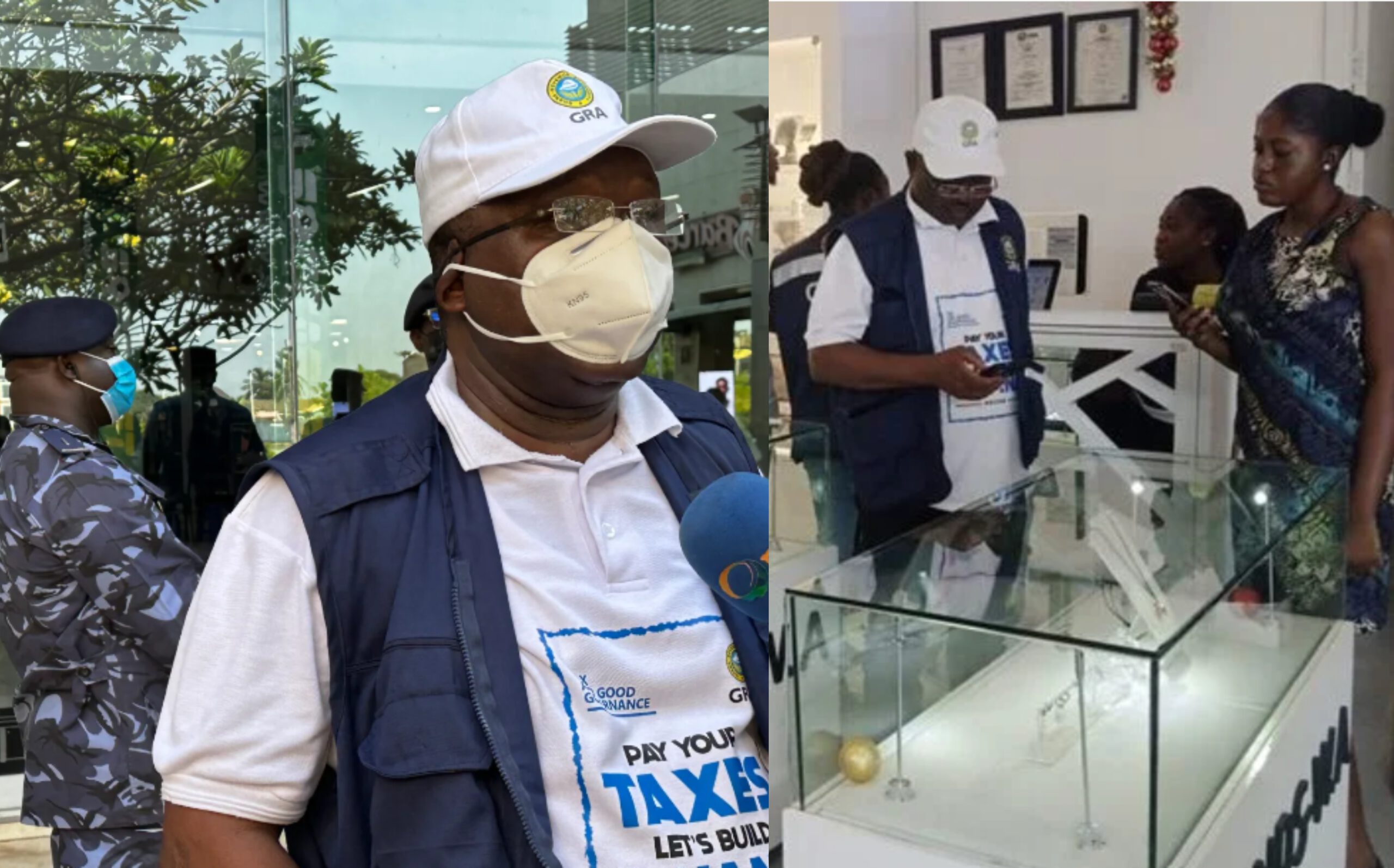
Shoppers at two major retail centres in Accra are being urged to insist on proper VAT invoices after the Ghana Revenue Authority (GRA) uncovered widespread tax-compliance problems during inspections at Achimota Retail Centre and the West Hills Mall enclave.
At Achimota Retail Centre, GRA officials inspected 14 shops and found compliance issues at almost all the businesses visited. A separate exercise at West Hills Mall identified 19 non-compliant shops out of 22 inspected, leaving only three fully compliant.
The breaches ranged from unauthorised invoicing and failure to issue VAT invoices to the continued application of an abolished flat-rate VAT arrangement.
The inspections are part of an intensified enforcement drive by the GRA to ensure businesses properly register, issue authorised invoices and account for taxes collected from customers.
What the GRA Found at the Two Shopping Centres
During the Achimota exercise, Joseph Adjeikwei Annan, an Assistant Commissioner and head of the GRA’s Accra Central Tax Enforcement Unit, said almost all 14 shops inspected had compliance issues.
Among the businesses cited, Euro Outfits was accused of using computer systems to generate invoices without GRA authorisation. The Authority took the company’s machines for examination and invited the business, which operates three branches, for further engagement.
D.O.H and Spendstre Ghana Limited were also cited for using their own machines to generate invoices without approval, while Centopia was accused of issuing unauthorised invoices.
The GRA also identified discrepancies involving Carrefour Ghana, which trades under the ShopRite name, and its business name and receipt system. Biju Ghana was cited for continuing to charge flat-rate VAT, while First Choice Hair and Beauty was accused of failing to issue invoices and operating under the abolished flat-rate arrangement.
MaxBuy, Art Kitchen and M.V. Company Limited were also cited over invoicing-related concerns.
At West Hills Mall, the Authority identified 19 non-compliant businesses out of 22 shops inspected.
The breaches included failure to register for VAT, unauthorised self-generated invoices, failure to issue VAT invoices and selective issuance of receipts.
The GRA cited Exclusive Signature for using self-generated invoices without authorisation, Grosvenor for selectively issuing VAT invoices and Aromatic Laundry for operating without VAT registration.
Other businesses named included Maxbuy Ghana Limited, which was registered for VAT but used its own invoices, Frank Phones, which was accused of failing to issue invoices, and Sweet Roses, whose business records were written in Chinese and required further examination.
Explaining one of the invoicing breaches at West Hills Mall, Annan said: “They are using their own machine to generate their invoice without authorization.”
The affected businesses were invited to the GRA’s offices for further examination. The Authority also collected records to support preliminary assessments and possible audits.
The findings were disclosed by GRA officials during media engagements. The public briefings did not include responses from the businesses named. The allegations should therefore be distinguished from final determinations following the Authority’s investigations.
What Has Changed Under Ghana’s VAT Reforms?
The inspections come after the introduction of the Value Added Tax Act, 2025 (Act 1151), which took effect on January 1, 2026.
One of the major changes was the abolition of the VAT Flat Rate Scheme, which previously applied different flat rates to certain supplies. The new system introduced a unified VAT structure.
Under the current arrangement, the standard VAT rate is 15 per cent, with the 2.5 per cent National Health Insurance Levy and 2.5 per cent Ghana Education Trust Fund Levy bringing the effective rate to 20 per cent on standard-rated taxable supplies.
The reforms also increased the VAT registration threshold for businesses dealing in goods from GH¢200,000 to GH¢750,000.
A subsequent amendment, the Value Added Tax (Amendment) Act, 2026 (Act 1177), extended the GH¢750,000 registration threshold to taxable supplies generally, including services, with effect from September 1, 2026. Businesses must register when their taxable supplies exceed the threshold within a period of 12 months or less, subject to the law’s other registration provisions.
Another important requirement concerns how VAT invoices are generated.
Under the new framework, businesses required to issue VAT invoices must use a GRA-approved invoicing system. Receipts generated through unauthorised software or machines may not qualify as valid VAT invoices.
How Shoppers Can Protect Themselves
The GRA has urged consumers to demand proper VAT invoices whenever they purchase goods or services from VAT-registered businesses.
An electronic VAT invoice or receipt generated through the GRA’s E-VAT system should contain identifiable security features, including:
- The Commissioner-General’s signature.
- A QR code for verification.
- The date and time of the transaction.
- A serial number and receipt number.
- A machine registration code.
- A receipt signature that cannot be altered.
These features help customers establish whether an electronic receipt was generated through the recognised VAT system.
The QR code is particularly important because it provides a means of verifying the authenticity of an electronic VAT invoice. Customers should check the details rather than simply accepting any printed or digital receipt as proof that VAT has been properly accounted for.
A general payment slip or handwritten receipt is not necessarily a valid VAT invoice. Shoppers should ask for the appropriate tax invoice when purchasing from a VAT-registered business.
Annan has also stressed that issuing invoices is an important part of the Authority’s compliance drive. Following the West Hills Mall inspection, he said: “GRA will therefore intensify its monitoring to ensure that taxpayers not only filed their returns and made payments but also issued the appropriate invoices whenever customers purchased goods or services.”
The GRA says issuing an invoice is only part of a business’s responsibility. VAT collected from customers must also be declared and paid to the Authority.
Annan has warned that businesses found violating the rules could face applicable interest and penalties. He has also urged consumers and business owners to verify the identities of people who approach them claiming to be GRA officials, warning that some individuals impersonate tax officers to defraud the public.
GRA Plans More Frequent Inspections
The Authority says its enforcement approach will include invoice monitoring, test purchases, commonly known as mystery shopping, and random compliance checks.
Annan indicated that the exercise would become a routine daily activity across GRA offices, rather than being limited to occasional enforcement campaigns.
The inspections are intended to make VAT compliance a routine part of doing business, with consumers playing an important role by requesting proper invoices and reporting suspected irregularities.
For businesses, the inspections are a reminder that compliance with the current VAT framework is not optional. Unauthorised invoicing, failure to account for VAT collected, and the continued use of abolished arrangements can attract sanctions.

