


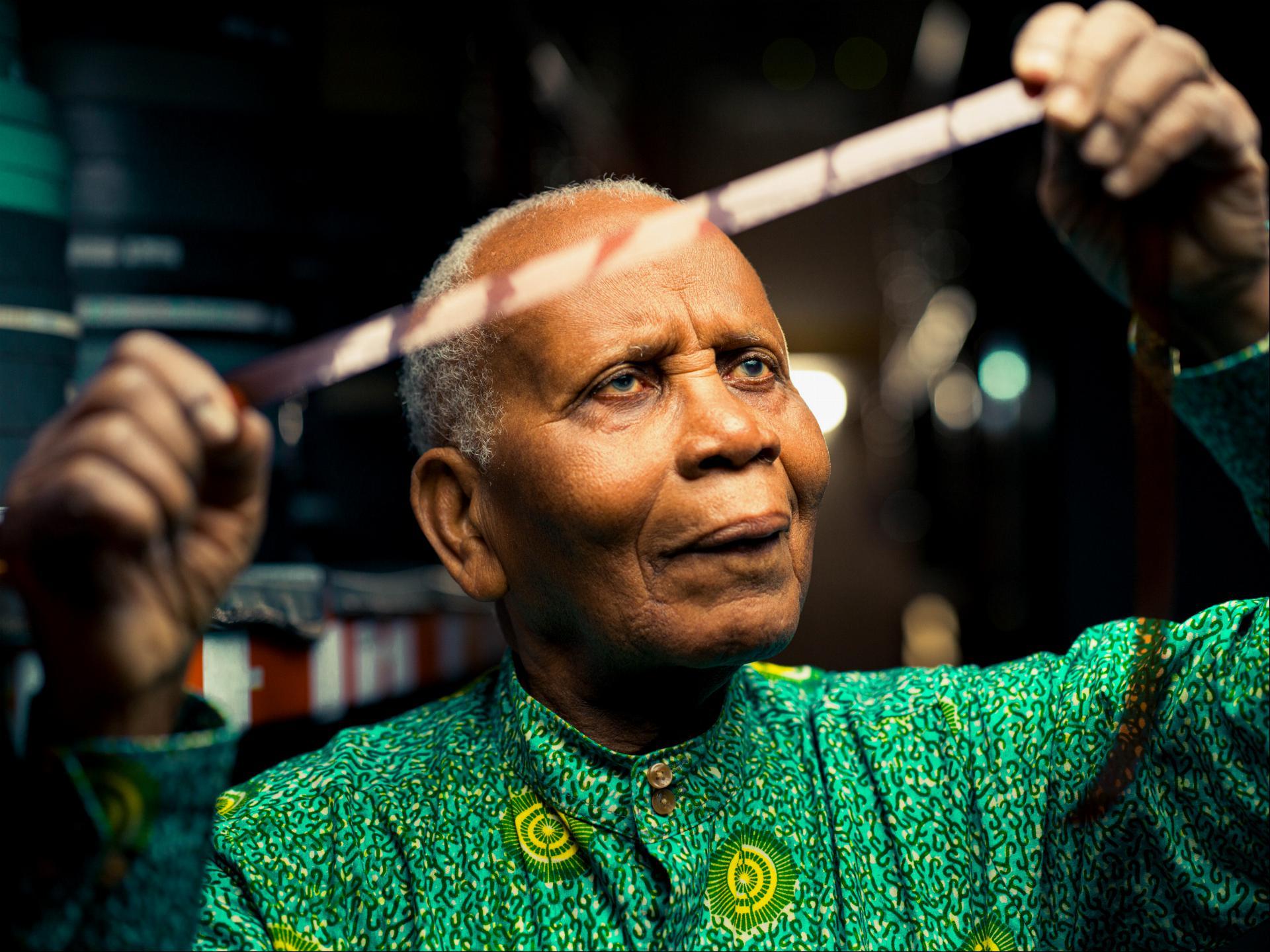
When Ghana’s first President, Dr Kwame Nkrumah, was overthrown in the 1966 coup, the upheaval put more than his government at risk. Film footage documenting his presidency and Ghana’s early independence years also faced destruction.
Much of the material was lost. But veteran cinematographer Rev. Dr Chris Tsui Hesse had arranged for copies of the footage to be preserved in London, helping save an extraordinary visual record of Ghana’s history and Africa’s liberation struggles.
Nearly six decades later, the 93-year-old filmmaker is receiving renewed recognition for the work, following a visit by President John Dramani Mahama on November 23, 2026.
The tribute has brought attention to a remarkable story of foresight and persistence, and to the man who understood that the images he was capturing would one day become part of Ghana’s national memory.
The Young Cameraman Nkrumah Trusted With His Story
Hesse served as the personal cameraman to Nkrumah, documenting the President’s activities in Ghana and during international travels throughout the 1950s and 1960s.
His appointment followed a period of persistently filming the then Prime Minister and following him wherever he went. Eventually, his work caught Nkrumah’s attention.
In the documentary The Eyes of Ghana, Hesse recalled receiving the news that he had been selected for the role.
He also remembered the responsibility Nkrumah placed on him.
“My son, I’m depending on you as the filmmaker to tell the story,” he recalled the former President telling him.
The assignment made Hesse responsible for capturing, directing and editing footage of Nkrumah’s activities. He described himself as a one-man film unit.
“All of a sudden, I’m a one-man film unit. I’m the cameraman, I’m the director, and I edit on my camera,” he said.
He travelled with Nkrumah, recording state visits, political engagements and encounters with international leaders. The resulting footage would become an important visual record of Ghana’s formative years and the wider African independence movement.
How the Film Archives Survived the 1966 Coup
The overthrow of Nkrumah in February 1966 placed the footage in danger. According to the documentary’s project account, material held by the former government was targeted for destruction.
But Hesse had made arrangements that would prove crucial.
In an interview about his work, he explained that Ghana did not have the facilities needed to process the colour film he was shooting.
“The main reason was that we didn’t have a colour lab here, and we’re shooting colour. So the best thing to do was to preserve everything in London,” he said.
That decision meant copies of the footage survived outside Ghana even as other material was destroyed.
The archive’s survival, however, did not end the struggle to protect it.
President Mahama recalled that when he served as Deputy Minister of Communications, Hesse took him to the Information Services Department to see old film reels that had deteriorated through age and mould.
Some could not be recovered.
Hesse later informed him that preserved copies of other films were being held at a Rank Xerox laboratory in London, but Ghana owed money for their storage. The company had reportedly threatened to dispose of the material if the outstanding bill was not paid.
Mahama recalled that the amount was about £10,000 and said he intervened to secure payment.
He explained that the government continued paying for the storage, but the arrangement eventually broke down after the NDC lost power in the 2000 elections.
The films were subsequently delivered to Ghana’s High Commission in London and kept in its basement.
Hesse continued working towards their preservation, eventually pursuing digitisation to protect the footage from further deterioration.
More Than 1,000 Reels of Ghanaian and African History
The scale of the collection makes the preservation effort particularly significant.
The Eyes of Ghana, directed by filmmaker Ben Proudfoot, follows Hesse’s work to protect more than 1,000 reels of footage, with the documentary’s project materials describing a collection of over 1,300 films.
The archive captures Ghana’s independence era, Nkrumah’s presidency and important moments in Africa’s struggle against colonial rule.
For historians and researchers, the footage offers something that written accounts alone cannot provide: moving images of the people, events and places that shaped the period.
The documentary also reveals the challenges involved in bringing the material back to life.
Proudfoot told POV Magazine in a November 2026 interview that 45 films had initially been digitised in 2K resolution using the documentary’s budget. They were selected because some were at risk of deterioration while others contained particularly important historical images.
He said the project had also sought to encourage the Ghanaian government to fund the digitisation of the remaining collection.
That funding has since been secured, with the rest of the archive being digitised in London, according to Proudfoot.
The development represents a significant step towards preserving a collection that has spent decades at risk of being lost.
Why Chris Hesse’s Work Matters
Hesse’s contribution goes beyond documenting the activities of a former President.
His footage provides a visual record of a generation that shaped Ghana’s political identity and influenced independence movements across Africa.
Reflecting on the significance of preserving the past, Hesse offered a simple explanation for his lifelong commitment.
“The past can make us free,” he said.
It is a powerful reminder of why historical archives matter. They allow future generations to examine events for themselves, understand the decisions that shaped their countries and question accounts of the past.
Mahama said he was pleased that footage from Nkrumah’s era was now being restored and shared, including clips circulating on social media.
He also explained why he had chosen to honour Hesse while he was still alive.
“Uncle, we came to honour you. Of course, you have been honoured by Eyes of Ghana, which has become very popular and famous. And so we said that we must honour you, not posthumously. When you die, then we will start crying. We must do it while you are alive,” he said.
The recognition is timely, but the preservation of the archive remains the bigger legacy.
With the digitisation of the remaining collection now underway, Ghana has an opportunity to ensure that the images Hesse worked so hard to protect are not only saved but also properly documented and made accessible to students, researchers, filmmakers and the wider public.
A man once entrusted with recording Ghana’s history has spent decades fighting to ensure that the country does not lose sight of it.

