


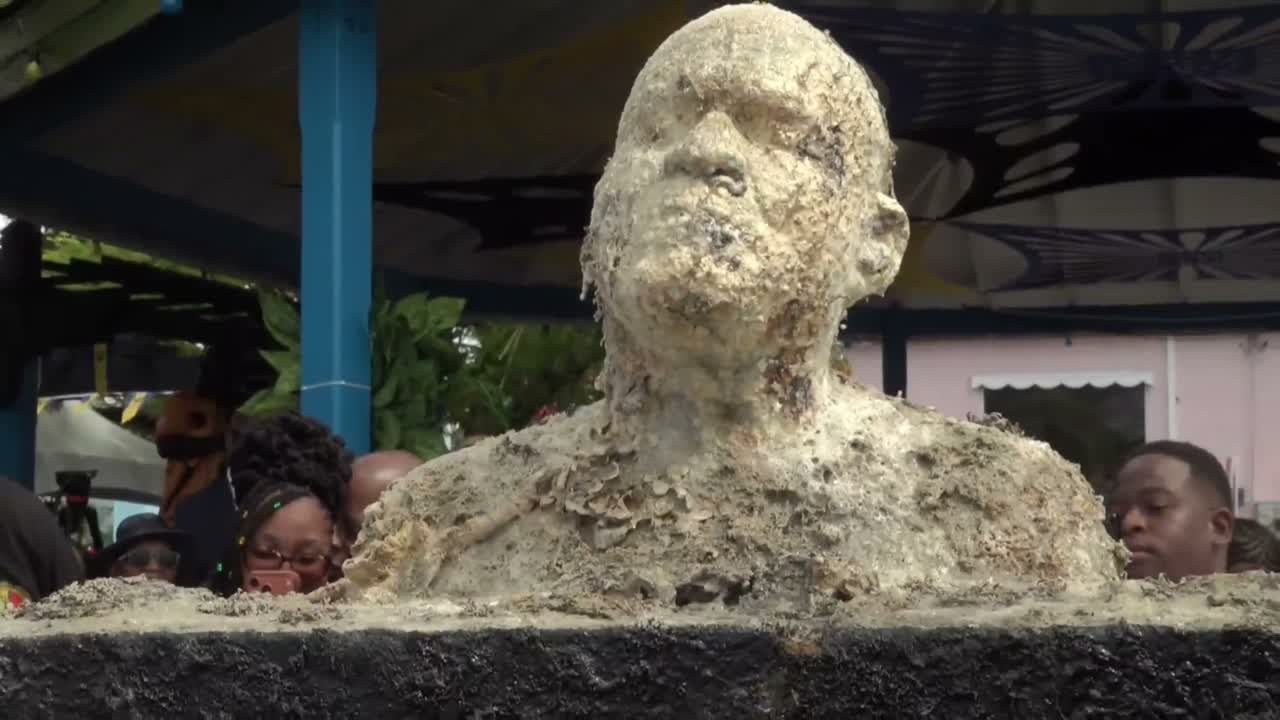
More than 350 years after a planned uprising against slavery was uncovered in Barbados, a man remembered as King Cuffee has received a public memorial in the Caribbean, renewing attention on a little-known chapter of Ghana’s historical connection with the island.
On November 27, 2026, President John Dramani Mahama and Barbados Prime Minister Mia Amor Mottley unveiled a bust of Cuffee at Speightstown, where a planned uprising in 1675 was intended to make him king.
The ceremony also marked the formal twinning of Speightstown and Cape Coast, two communities linked by the transatlantic slave trade.
But who was Cuffee, and what do historical records actually tell us about the man whose planned coronation has become part of Barbados’ history?
Who Was King Cuffee?
One of the earliest surviving accounts of Cuffee appears in a London pamphlet published in 1676, titled Great Newes from the Barbadoes.
It described him as “an Ancient Gold-Cost Negro” who was to be crowned on June 12, 1675, in a specially carved chair of state.
The pamphlet called him “Coffee”, a name associated with the later spelling Cuffee or Cuffy. Historian Jerome S. Handler, in his 1982 study Slave Revolts and Conspiracies in Seventeenth-Century Barbados, notes that the name may derive from the West African or Akan day-name Kofi, traditionally given to boys born on Friday.
The contemporary account identifies Cuffee as being from the Gold Coast, the historical name used for parts of West Africa that include present-day Ghana. Barbados’ Office of Pan African Affairs and Heritage has identified Cape Coast as his place of origin, a connection highlighted during the recent twinning ceremony.
However, the 1676 pamphlet does not specify Cape Coast or provide details of his early life. His exact birthplace, family background and circumstances of enslavement remain unclear.
The 1675 Plot To Overthrow Plantation Rule
The planned uprising involved enslaved Africans from several plantations and was reportedly organised over about three years.
According to the 1676 pamphlet, the conspirators intended to coordinate a general rising using signals from trumpets made from elephant tusks and gourds. Fires would be set in sugar-cane fields, while enslaved people on different plantations would attack their enslavers.
The plan included establishing a new political order under an African king. Cuffee was the man selected for the proposed position, with his coronation scheduled for June 12, 1675.
The uprising never took place. The plot was discovered before the planned attacks could begin.
Handler’s research, drawing on contemporary records, says the conspiracy was exposed after an enslaved woman named Anna or Fortunna overheard a conversation about the plan and informed her enslaver. The information reached the governor, who ordered arrests.
At least 107 enslaved people were implicated. Seventeen were initially executed, including six who were burned alive and 11 who were beheaded. Handler records that another 25 were subsequently executed.
The punishment was intended not only to deal with those accused but also to deter further resistance. The discovery of the conspiracy prompted the colonial authorities to strengthen military arrangements and tighten laws governing enslaved people.
Was Cuffee The Leader Of The Conspiracy?
Although Cuffee was identified as the man intended to become king, the historical evidence does not establish that he personally planned or directed the uprising.
Handler makes this distinction explicitly, writing: “Nothing, however, is known about Cuffy and his role, if any, in the planning or formulating of the plot.”
The historian describes the conspiracy as a collective effort to seize control of the island, rather than an undertaking that can confidently be attributed to one individual.
This matters because much of what is known about the plot comes from colonial accounts written by people who viewed the enslaved Africans as a threat to plantation rule. Those records preserve important details, but they do not provide the conspirators’ own accounts of their intentions or experiences.
Handler also notes that the majority of those implicated were identified as Coromantee or Gold Coast Africans, most of whom were probably Akan speakers. Other African-born people were involved as well.
The proposed chair of state is another revealing detail. Handler explains that the stool held political and cultural significance among Akan and related peoples, representing authority and collective identity. Its inclusion suggests that African political traditions remained influential among people forcibly taken across the Atlantic.
Why Cuffee Matters To Ghana And Barbados
Cuffee’s story connects two places shaped by the transatlantic slave trade.
Cape Coast was a major departure point for enslaved Africans taken from the Gold Coast. Speightstown, historically known as Little Bristol, was among the early ports through which enslaved Africans arrived in Barbados.
The 1675 conspiracy was part of a wider history of resistance to slavery in the Caribbean. Barbados later experienced an actual uprising in 1816, led by the enslaved man remembered as Bussa.
Handler makes an important distinction between the two events: the 1675 conspiracy was discovered before it could be carried out, while the 1816 uprising actually took place.
For Barbados, Cuffee has become a symbol of the resistance that existed long before emancipation. For Ghana, his story offers a connection to Africans who resisted enslavement after being forcibly taken from the continent.
Speaking at the unveiling, Mahama said the story reminded people that their ancestors were “not just passive victims, but courageous agents of resistance whose determination shaped the struggle for freedom and dignity.”
Mottley also reflected on the significance of the memorial, saying: “Cuffee was promised a crown here in Speightstown and regrettably he was denied it. We cannot give him that crown today, but we can give him something greater.”
More Than A Monument
The bust unveiling was accompanied by the formal twinning of Speightstown and Cape Coast, creating a framework for cooperation in education, culture, tourism and community development.
Mahama urged the two communities to make the agreement meaningful through practical exchanges, including opportunities for schoolchildren from both towns to study in each other’s schools. Mottley expressed support for the idea.
The partnership offers an opportunity to move beyond commemorative ceremonies and help younger generations understand the history connecting Ghana and the Caribbean.
Cuffee’s full biography may never be recovered. The surviving records do not establish his exact birthplace or personal role in organising the conspiracy, and they do not confirm what ultimately happened to him.
But they preserve the account of a man selected to become king in a planned challenge to slavery, alongside the memory of the many others who risked their lives in the conspiracy.
More than three centuries later, his story is being recognised on both sides of the Atlantic. The challenge for Ghana and Barbados is to ensure that the renewed connection preserves not only the memory of those who were taken, but also the courage of those who resisted.

