


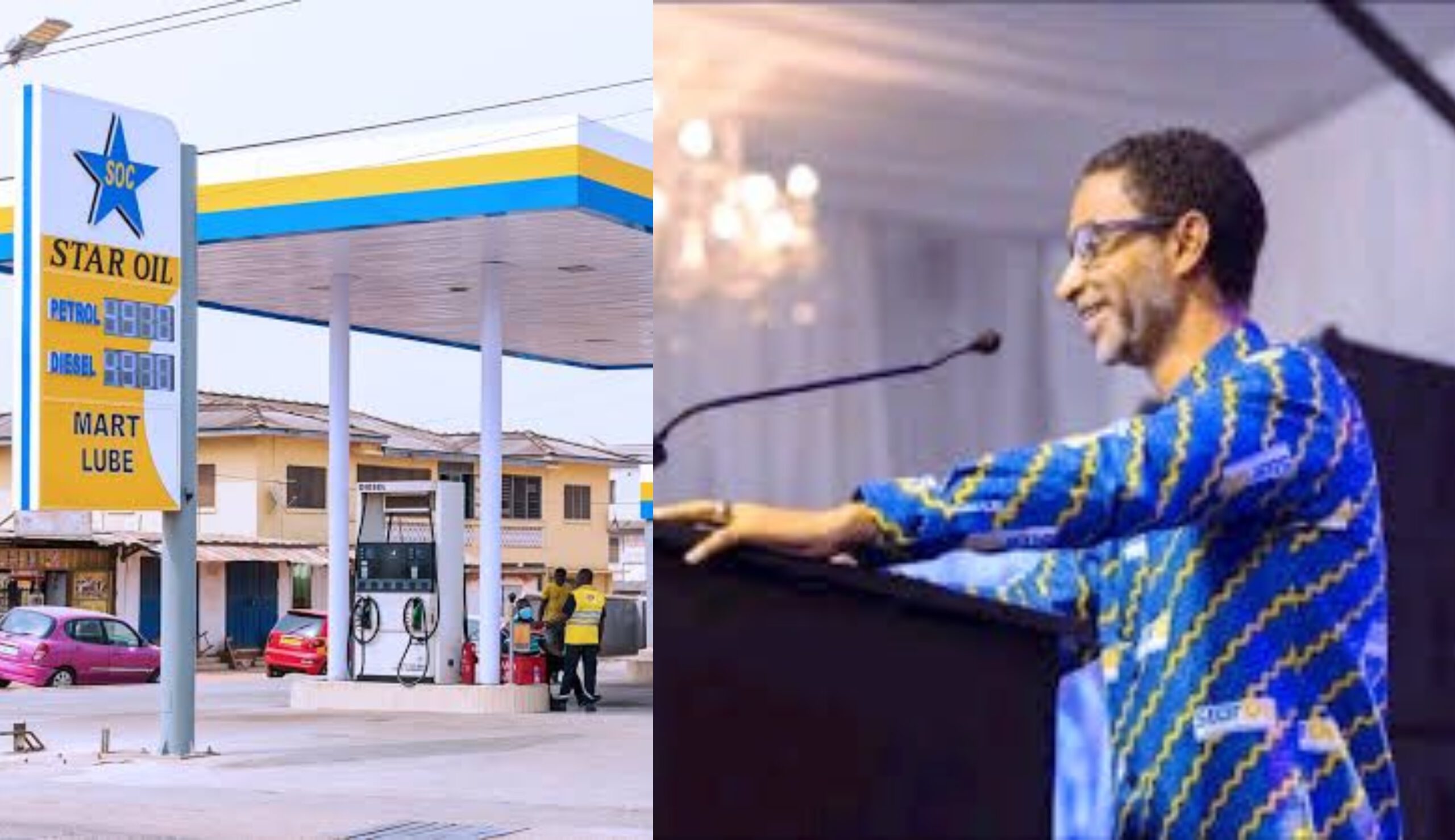
Star Oil CEO Kwame Tieku has attributed part of the company’s long-term growth and sustainability to a deliberate shift away from selling fuel to companies on credit, saying the experience taught the business to place greater emphasis on cash flow and financial discipline.
Reflecting on his 12 years with Star Oil, Tieku said in a series of social media posts that credit sales had exposed the company to customers who delayed or resisted repayment, with some debts eventually requiring legal action.
10 Best-Performing Stocks on the Ghana Stock Exchange Right Now
“If you have been running a business in Ghana and selling on credit, I’m sure you have a lot to tell about credit risk in Ghana,” Tieku wrote in a Facebook post.
He said Star Oil’s decision to move “substantially away from credit sales to companies” was one of the reasons he believes the company has reached its current position.
How Credit Risk Shaped Star Oil’s Business Strategy
According to Tieku, some companies that had previously caused Star Oil significant difficulties over unpaid debts later returned seeking to do business with the company.
However, he said Star Oil has refused to resume supplying some of them even when they offered bank guarantees.
“We like our fuel station business like that! Cash is king wai,” he wrote.
Tieku also recalled a case in which Star Oil took a debtor to court in an attempt to recover money owed to the company.
He said the debtor went to court and disputed owing Star Oil, prolonging the recovery process. Years later, according to Tieku, the same customer returned with a bank guarantee.
Star Oil nevertheless declined to resume the credit arrangement.
For a fuel business, unpaid invoices can tie up working capital that could otherwise be used to finance operations and expansion.
‘Your Word Must Be Your Bond’
For Tieku, financial discipline also extends to a company’s relationships with suppliers and banks.
“If you want to grow your business to become an industry leader, your word must be your bond!” he wrote.
He added:
“Your suppliers and bankers will support your growth when they know you have been faithful with little every step of the way! That’s the story of Star Oil.”
Africa’s Gold Refining Shift: How 12 Countries Are Seeking To Retain More Value
Tieku has now offered a more concrete illustration of why access to credit matters to Star Oil as the business has expanded.
In another Facebook post, he said Star Oil’s working-capital requirement had increased sharply between January and September 2026.
“In Jan’26 Star Oil was OK with a working capital line of GHS500m. Now we need GHS1.6B,” he wrote.
Tieku argued that if Star Oil’s suppliers required the company to operate strictly on cash-and-carry terms, it would have to find an additional GH¢1.1 billion to maintain its operations at its current scale.
“If suppliers were selling to us on strict cash & carry terms, where in Ghana would we get the 1.1B to remain in business? Don’t joke with your credit score,” he wrote.
The post highlights an important distinction in Star Oil’s approach to credit. While the company has reduced its willingness to extend credit to customers, it still relies on access to working-capital financing and supplier credit to support a much larger operation.
Star Oil’s financing history helps put that distinction into context. The company says Tieku joined as Financial Controller in January 2014 and spent the following six years securing working capital and long-term financing while helping the business transition towards a predominantly Company Owned Company Operated model.
Star Oil’s Position In Ghana’s OMC Market
Star Oil has established itself as a leading player in Ghana’s oil marketing industry, with National Petroleum Authority data placing the company first by petroleum-product sales volume in Q1, Q2 and Q4 of 2025.
In Q1, Star Oil recorded 155,663 metric tonnes, representing a 10.80% market share. In Q2, it recorded 165,160 metric tonnes and a 10.89% share.
In Q4, Star Oil recorded 171,813 metric tonnes, representing a 10.63% market share, compared with 10.01% for GOIL.
The figures provide independent evidence of Star Oil’s market position during those periods, but they do not establish that its decision to reduce credit sales was the direct cause of its growth.
‘Cash Is King’
Tieku also extended his comments beyond corporate credit, warning about individuals who maintain expensive lifestyles using credit without a clear intention or ability to repay.
“Some people live expensive lifestyles on credit they never plan to pay. The banks can tell you so many stories about that,” he wrote.
His broader point is that financial obligations can become a constraint when they are not matched by the ability to repay.
For businesses, credit can support sales and customer relationships, but prolonged non-payment can put pressure on cash flow.
How Star Oil Grew Into A Market Leader
The credit policy is one part of the story of Star Oil’s expansion. The company has also undergone significant changes in its operations, financing and retail network.
Star Oil was incorporated in 1998 as a wholly Ghanaian-owned oil marketing company. The company describes itself as Ghana’s oldest independent OMC without foreign or state ownership.
Tieku joined the company in January 2014 as Financial Controller. According to Star Oil’s corporate profile, he spent the following six years securing working capital and long-term financing while helping the company move from a predominantly Dealer Owned Dealer Operated (DODO) model to a predominantly Company Owned Company Operated (COCO) model.
He became CEO in September 2020.
In a March 2026 interview, Tieku said Star Oil had grown from about the 13th-largest OMC in Ghana by sales volume to the top position in five years.
Its station network increased from 85 in 2020 to 254 by March 2026, while its workforce reached about 2,700.
Pricing And Direct Operational Control
Pricing has also featured in Star Oil’s expansion.
The Association of Oil Marketing Companies, in a 2024 newsletter, identified Star Oil’s low-pricing strategy, introduced in July 2021, as one factor behind its growing market share. The association reported that Star Oil had 195 filling stations at the time.
Tieku has pointed to supply-chain efficiency as part of the company’s approach, with the aim of using operational gains to support more competitive prices.
Greater direct control over its stations was another part of the company’s operating model.
In a 2021 interview with The Energy Year, Tieku said Star Oil operated stations with its own staff rather than third parties, arguing that direct control helped the company manage losses arising from theft and other operational incidents.
Star Oil’s expansion from 85 stations in 2020 to 254 by March 2026 took place alongside these changes to its operating model.
What Comes Next For Star Oil
Star Oil’s strategy is now extending beyond the expansion of its filling station network.
In March 2026, Tieku outlined plans involving real-time monitoring of stations, greater payment integration and the Star Savers app.
He also said the company was pursuing a licence to import petroleum products directly, which he expects could improve efficiency and reduce costs.
Selected Star Oil locations are also expected to eventually include electric vehicle charging facilities and shopping services.
The company’s expansion is also taking place as Ghana’s downstream petroleum sector undergoes wider changes, including efforts to increase domestic refining capacity.
For Tieku, financial discipline remains an important part of sustaining the company’s growth as Star Oil continues to expand its operations.

